
Gas-phase etching for faster MXene manufacturing
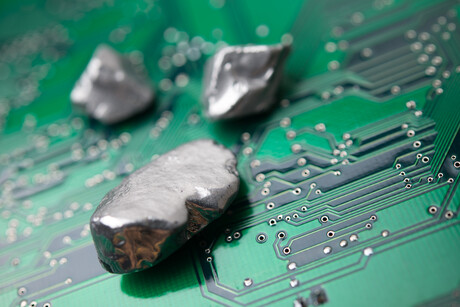
MXenes are two-dimensional materials made of very thin layers of metals, measured on the atomic scale. They conduct electricity well and have surfaces that can easily interact with other materials, which makes them excellent candidates for advanced electronic devices and computers, and advanced coatings for aerospace applications. However, building MXenes requires a long, hydrofluoric acid-filled process called liquid-phase chemical etching. Now, a group of researchers led by James Tour, the T.T. and W. F. Chao Professor of Chemistry at Rice University, has built an ultra-fast MXene synthesis process using gas-phase etching.
To synthesise MXenes, researchers often start with a MAX phase material, which contains layers of transition metals sandwiching a thin layer of a third element. For example, a MAX might have titanium and carbon ‘bread slices’ with an aluminium ‘filling’. To make a MAX into an MXene, the aluminium layer would need to be removed and a thin surface layer, which allows for easy interaction with other materials and chemicals, placed on top. In sandwich terms, it would be like removing the peanut butter from a peanut butter sandwich and adding a bit of butter to the top slice of bread.
To do this with liquid-phase chemical etching, acids are used to slowly dissolve away the middle layer through a series of etch steps and then to add on the reactive surface layer. But this involves many hours or days of treatment and produces large amounts of toxic hydrogen fluoride, keeping the price of MXenes high and their availability low.
“I don’t normally work on MXenes, but my lab mate sent me a paper describing a 12- to 24-hour MXene etching process,” said Shichen Xu, a postdoctoral researcher in the Tour lab. “That made me wonder if our ultrafast flash Joule heating could be used to speed up the process. I decided to try it, and it worked — the very first time!”
To use the flash Joule heating, Xu turned from liquid-phase etching to gas-phase etching. Instead of acids, he rapidly heated his MAX material then added a combination of chlorine gas and tetrafluoromethane gas. The gas mixture reacted with the MAX phase and selectively removed the aluminium layers, converting the MAX phase into an MXene. The entire process took less than 30 seconds, and the switch from hours of acid to just 10 seconds of seconds of gas could greatly reduce risk in a properly controlled manufacturing process, while also reducing toxic waste.
“The switch to gas supports not only a faster process but a more controllable one,” Xu said. “The gas composition and exposure time can be adjusted to control the extent of etching.”
The new method also showed different efficiencies and selectivity when removing the middle layer, which also allowed for more control over the delicate process. Since each layer is only a few atoms thick, the etching method needs to be very selective for only the filling with minimal damages to the metals serving as the slices of bread.
“This method highlights the flexibility and usability of the flash Joule heating method,” Tour said. “Ultimately, with our ultrafast heating method, we’ve developed a faster, more controllable and far more scalable way of manufacturing MXenes, a material with great applications for catalysis, electronic devices and aerospace coatings.”
Electrical method could help detect extraterrestrial life
An AI-powered nanogap method can distinguish amino-acid forms, opening a path to compact...
Research identifies hidden network latency bottlenecks
Researchers have identified hidden network latency bottlenecks, revealing where delays occur and...
Optical isolators integrated on silicon photonics chips
A new laser-annealing process integrates optical isolators directly onto silicon photonics chips,...


