New insights into hybrid LED efficiency
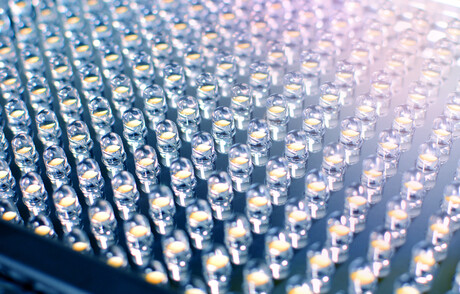
Chemists have developed a way to improve the performance of light-emitting diodes (LEDs) made with perovskite. This advancement holds potential for a range of uses, including biomedical sensing, low-light imaging and automated facial recognition.
The research findings have been published in the journal Nature. Most previous work in perovskite LEDs has yielded rates of quantum efficiency — the ability to convert electricity to light — within a range of 20–30%.
“Our discovery leads to an efficiency rate closer to 40%. That’s a big jump,” said Letian Dou, senior author of the paper and professor of chemistry at Emory University.
“We uncovered hidden mechanisms in the solution used to make these devices that had been previously overlooked,” said Sung-Doo Baek, first author of the paper.
The insight enabled the researchers to improve the synthesis process — boosting the yield of a compound that enhances the efficiency of a perovskite LED while suppressing the production of a compound that harms efficiency.
From incandescent light to LEDs
Starting in the 2010s, LEDs made from inorganic semiconductors, such as gallium nitride, began largely replacing incandescent lightbulbs in households. Incandescent bulbs work by heating a metal filament, causing them to waste 90% of their energy. LEDs convert energy directly into light by passing electric current through a semiconductor material to excite electrons. As a result, an inorganic LED uses only 8 to 10 watts to produce the same amount of light as a 60-watt incandescent bulb.
While inorganic LEDs are efficient, stable and long-lasting, they can be difficult to assemble into large-area displays or to shrink into extremely small pixels. In addition, they are rigid, making them more difficult to incorporate into flexible devices and some other applications.
LEDs made with organic molecules are thinner, more flexible, more designable and known for producing more brilliant colours in displays. However, they are currently more expensive to produce and less efficient and durable than inorganic LEDs.
Leading hybrid LED research
One focus of Dou’s lab is hybrid LEDs made of metal-halide perovskite — a material that combines organic and inorganic molecules. His lab is working to develop lightweight, flexible, hybrid LEDs that are also low-cost, durable and efficient in the near-infrared region — light found just past what is visible to the human eye.
“There are many important applications for LEDs in the near-infrared region. For example, the facial recognition feature on your cell phone. Infrared light avoids having a beam of blue light hit you in the eye. It is also used in night-vision cameras to monitor a baby sleeping,” Dou said.
Another key area for infrared light is biomedicine. Its longer light wavelengths can provide clear, non-invasive imaging of tissues for a range of applications, from tracking immune responses to detecting abnormal tissue cells.
For the current paper, the researchers wanted to improve the efficiency of perovskite LEDs to help move them closer to their potential for commercial applications.
A laboratory mystery
To make a perovskite LED, metal halide salts, along with various additives, are heated so that they dissolve into a solvent.
The solution is spin-coated in ultrathin layers onto a substrate inside a nitrogen glove box — a sealed, clear-walled enclosure filled with purified nitrogen gas. The box protects the material from the effects of oxygen and moisture. A researcher slips their hands into gloves attached to the box to work with the material.
Next, the ultrathin film is heated to evaporate the solvent and allow the chemicals to form a crystalline perovskite structure.
During the process of producing perovskite LEDs for experimentation and testing, Baek noticed something odd. The basic formulation for making a perovskite LED includes an additive, discovered in 2018, that delivers an LED with a baseline efficiency of 20–25%. But a batch made by the Dou lab somehow showed an efficiency rate of around 30%.
What accounted for that difference?
Finding a hidden mechanism
First, Baek checked the nitrogen glove box to see if any oxygen was leaking in. Although oxygen is usually considered harmful to perovskite materials, a few studies had suggested it could sometimes be beneficial. Baek wondered whether that was happening here.
“That turned out to be a false trail,” Baek said.
Next, he decided to investigate the hidden chemistry of the solution. The researchers kept tweaking the process of making the solution, producing the LEDs and comparing efficiencies.
After months of painstaking experimentation, they found that differences in how long the solutions were heated led to variations in efficiency. Twenty minutes of heating turned out to be the sweet spot.
The team also performed comparative analyses to determine how the chemistry transforms during the solution phase. They found that optimal heating favours the formation of a linear compound that boosts the efficiency of the LED and, at the same time, suppresses the formation of a ring compound that harms the efficiency.
They synthesised and purified the linear compound and developed a method of targeted reaction-pathway control to selectively harness its power. The result further boosted the efficiency of a perovskite LED to a peak of 37%.
The work sets the stage for a new chemistry-driven strategy for additive design to help drive further improvements.
“We are working to keep improving the efficiency and the operational lifetime of perovskite LEDs. We also want to move towards applications by demonstrating the relevance of this technology in biomedical research,” Dou said.
New approach brings OLEDs to microchip scale
A new approach uses photolithography to create densely packed OLED pixels, opening a path towards...
Analog memory boosts computing efficiency
Researchers have developed a new computer memory technology, known as electro-thermo-chemical...
New transistor brings high voltage to microchip scale
By harnessing the properties of gallium nitride, EPFL engineers have built a tiny transistor that...