
High-entropy design enables next-gen semiconductors
Semiconductors such as silicon are the cornerstone of today’s essential technologies; however, the variety of materials available to power devices is limited. While metal oxides are durable, only a small subset is semiconducting as they are naturally insulators.
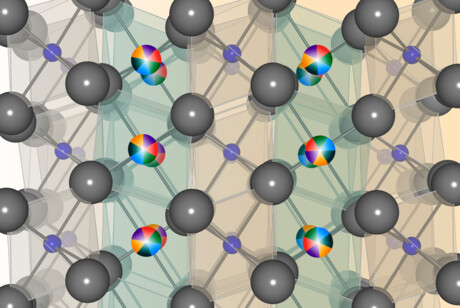
Researchers from Carnegie Mellon University and Penn State University have transformed an insulating metal oxide into a high-performance semiconductor by using a technique called high-entropy mixing. Developing a complex mixture of manganese, iron, cobalt, nickel, copper and zinc into a tungsten oxide framework within a single crystal structure, called wolframite, the researchers created a state of high configurational entropy. The new material, A6WO4, possesses both semiconducting properties and ultra-low thermal conductivity, making it an ideal formulation for thermoelectric devices.
“This approach activates unique microscopic mechanisms that we believe could serve as a new set of guiding principles for future materials engineering and design of next-generation devices,” said Ismaila Dabo, professor of materials science and engineering who contributed to this research.
High-entropy materials are created by mixing multiple elements into equivalent positions within a crystal lattice, creating a high degree of chemical disorder. This disorder not only changes the material’s composition, but it also fundamentally alters its physics. The researchers found that this ‘chaos’ at the atomic level triggered several microscopic mechanisms that narrowed the material’s band gap, transforming it from an insulating oxide into a semiconductor.
As the researchers tested this new formula, they determined that it exhibited ultra-low thermal conductivity at levels significantly lower than many common industrial semiconductors and standard thermoelectric materials. This was attributed to chemical disorder, which prevented heat flow and disrupted the paths through which heat usually travels.
“What stood out experimentally is that this material combines semiconducting transport with exceptionally poor heat conduction — two properties that are difficult to achieve together in oxides,” said Zhiqiang Mao, professor of physics at Penn State and co-author of the study. “The measurements show that high-entropy mixing is not just a way to create chemical disorder; it can be used as a powerful knob to engineer electronic and thermal properties simultaneously.”
The potential impact of this research on the semiconductor industry is significant because it provides a strategy that could turn resources that are more abundant and readily available into functional semiconductors.
Thermoelectric devices that convert waste heat into electricity require materials that conduct electricity like a metal, but scatter phonons to block heat like a glass. The A6WO4 system demonstrates a design that can achieve both goals simultaneously. Additionally, metal oxides are often more resilient to heat and environmental damage than traditional semiconductors, making them ideal for applications in extreme conditions.
Degrading dopants could enhance semiconductor performance
A new doping method produces up to 100 times more mobile charges in organic semiconductors,...
Nanoscale polar whirlpools emerge in atom-thin semiconductors
Tiny polar whirlpools found in atom-thin tungsten diselenide could enable new approaches to...
Magnetoelectric material could enable lower-power memory
A new magnetoelectric material could enable lower-power computer memory by allowing magnetic...



