Plasma beam antenna transmits radio waves with lasers
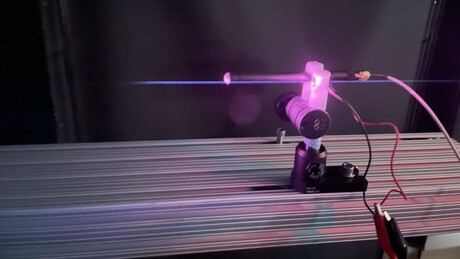
Researchers have demonstrated a technique that uses a laser to produce a plasma beam antenna capable of transmitting radio waves.
“The plasma beam antenna looks like a lightsabre and is tuneable, meaning we should be able to transmit across a broad range of frequencies,” said Prya Darshni, corresponding author of a journal article on the work and a PhD student at North Carolina State University. “And while we have not demonstrated its ability to serve as an antenna that can receive radio signals, there’s no reason to believe it wouldn’t also work as a receiver.”
The length of an antenna is important because it controls the frequencies at which radio waves can be transmitted and received. But manipulating the length of antennas to sweep a desired range of frequencies can be challenging in some applications — such as space exploration technologies.
“One of the questions we wanted to explore with this work was whether it would be possible to create plasma antennas using lasers, which would allow us to generate antennas at whatever length was needed. And we have now shown that it is possible,” Darshni said.
By firing a laser beam of a specific power and diameter, the researchers are able to ionise a thin beam of air, creating a defined shaft of plasma called a plasma filament.
But in order to make the plasma antenna a practical tool, the researchers also needed to develop a way to connect the antenna to radio technology in order to transmit a radio signal.
To solve that problem, the researchers also created and demonstrated a contactless antenna-feed, which consists of a metal ring that serves as a capacitor. The laser passes through the ring, creating a plasma filament that is surrounded by the capacitor. By generating an electromagnetic field with the capacitor, the researchers are able to interact with the plasma beam without touching it.
Altogether, the process works like this: a radio frequency generator feeds a signal into the capacitor; this generates the appropriate electromagnetic field, which then causes the plasma filament antenna to transmit radio waves at the appropriate frequency.
“By controlling the parameters of the laser, you can control the characteristics of the plasma filament — including its length,” Darshni said. “This is valuable for applications where you need an antenna that can sweep all frequencies. But there’s another benefit as well.
“There are also applications where it is important to be able to control the angle of the antenna, in order to target the direction of radar sweeps or to improve the strength of a signal you want to pick up. The technique we’ve demonstrated here would allow users to control the angle of the plasma filament antenna via beam steering — simply shifting the direction of the laser,” Darshni said.
In the long term, the technology holds promise for use in a variety of applications.
The article has been published in the IEEE Journal of Microwaves.
Degrading dopants could enhance semiconductor performance
A new doping method produces up to 100 times more mobile charges in organic semiconductors,...
Nanoscale polar whirlpools emerge in atom-thin semiconductors
Tiny polar whirlpools found in atom-thin tungsten diselenide could enable new approaches to...
Magnetoelectric material could enable lower-power memory
A new magnetoelectric material could enable lower-power computer memory by allowing magnetic...