Contact method enhances perovskite solar cell efficiency
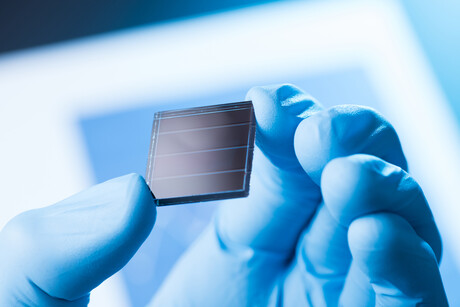
Researchers from Korea University and the University of Surrey have demonstrated a technique that improves the performance and stability of next-generation solar cells, without adding any chemicals or coatings.
The study, which has been published in Nature Energy, details a method that works by placing two types of perovskite film in contact with each other. That contact alone triggers a molecular interaction at the interface, which reorganises the crystal structure of the light-absorbing layer throughout its entire depth. The result is a more ordered, more durable material that converts sunlight into electricity more efficiently.
Solar cells built using this technique achieved a certified power conversion efficiency of 25.61%, independently verified by the Solar Energy Research Institute of Singapore.
Perovskite solar cells have attracted significant research interest because they are cheaper and easier to manufacture than conventional silicon-based panels. Their commercial potential has been limited, however, by questions over how well they hold up under the heat and humidity conditions of real-world deployment.
Under accelerated aging tests, the treated material required roughly twice the thermal energy to degrade compared with materials reported in recent literature — a meaningful improvement in a field where long-term stability is the central challenge.
The technique works through what the researchers call contact-triggered cationic interaction (CCI). When two perovskite films are placed in physical contact, molecular forces at the interface cause the charged particles — cations — within the light-absorbing layer to adopt a more uniform, aligned arrangement. This reduces the structural defects that cause energy to be lost as heat rather than converted to electricity. The time that charge carriers survive before recombining, a key measure of solar cell quality, increased from 4.48 to 5.89 microseconds in treated material compared with untreated controls.
To confirm this, the Surrey team used photo-induced force microscopy (PiFM) — a technique that maps chemical signatures at the nanoscale by combining the high resolution of atomic force microscopy with infrared spectroscopy, bypassing the diffraction limit of light. This allowed the researchers to visually validate the precise, uniform formation of chemical bonds triggered by the CCI process, confirming that the molecular alignment occurred exactly as predicted at the film interface.
“This study demonstrates that you can meaningfully improve both the efficiency and the durability of perovskite solar cells without adding a single extra chemical or processing step — just by controlling how two films interact at the point of contact. That is a genuinely elegant result, and the performance numbers back it up. This kind of advance matters because stability under real-world conditions is the central challenge the field has to solve before perovskites can be deployed at scale,” said Ravi Silva, Head of the NanoElectronics Centre at the University of Surrey.
Smarter charging boosts lithium–tellurium battery performance
An optimised charging strategy could improve lithium–tellurium battery performance by...
Flexible porous material may improve solid-state batteries
A flexible porous material could address contact issues in solid-state batteries, potentially...
X-ray spectroscopy could enable longer-lasting batteries
X-ray spectroscopy and computer modelling offer a faster way to predict chemical interactions and...