Battery-free smart home sensors developed using metal tags
Most smart home devices require power one way or another. You have to plug them in, recharge them or replace their batteries at some point.
Georgia Tech researchers think they have a better way with small metal tags that can signal when a door or drawer is opened, count reps in the gym or even track bathroom use for elderly relatives. Their tags are battery-free, quiet, inherently private and cost only a few cents each. They’re smaller than a penny.
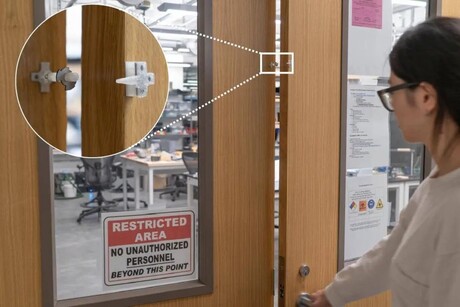
Like other kinds of smart home sensors, the tags are designed to be mounted on a cabinet or doorframe, for example, using a 3D-printed base. A small tab is attached to the corresponding door or drawer. When it’s opened, the tab strikes the metal disk, triggering a brief ultrasonic pulse imperceptible to human ears but detectable by a wearable device that logs the activity.
The shape of the metal tag — a small disk with a hole in the centre like a flat washer and various cut-outs along the outer edge — determines the frequency of the sound, so each tag can be uniquely identified.
“Those unique fingerprints can be used for smart home sensing, or what we call ‘activity recognition’,” said Yibo Fu, a robotics PhD student who led development of the tags with other engineering and computing researchers.
Fu said the tags could be attached to faucets to help monitor water use or toilet lids to alert caregivers that an elderly relative might need assistance in the bathroom. Attached to weights in the gym, they could count squats or presses. Users could manually press button versions to trigger a timer or log an activity.
Bolei Deng in the Daniel Guggenheim School of Aerospace Engineering specialises in vibration and waves and how the geometry of an object influences its resonance. He and his team created a modelling and simulation tool to design the metal disks so they would generate specific ultrasonic frequencies when they’re struck.
Their simulations identified nearly 1300 initial designs that would each produce a unique frequency in the ultrasound range. Those frequencies are above 20 kilohertz, which is the upper limit of sounds humans can hear. The team used 15 of the proposed designs in their tests.
“We could select 20 or 50 or 100 designs and it most likely still works,” Deng said. “And with more careful design, I think the total number of available tags can be very, very large — easily thousands — because the ultrasound frequency range is very broad.”
Using ultrasound presents advantages beyond the tags’ silence to human ears. They’re easy to pick out even in noisy environments. And they don’t travel very far, so only nearby microphones would ‘hear’ the tag. That makes the devices inherently private, Deng said, because other people wouldn’t detect any activity unless they were within a metre or so.
One other way the researchers worked to keep their system simple: they did not use any complicated machine learning algorithms to detect the ultrasound signatures. Instead, they created an algorithm with simple, hardcoded rules. That approach means identifying signals requires little computational and electrical power.
Along with Deng, Fu worked on the tags with School of Interactive Computing researchers Alexander Adams and Josiah Hester.
“This has really been a collaboration between computing and engineering,” Fu said. “There is the physics simulation part, but also there’s the computing we needed to design the algorithm for reading the signals.”
Graphene hydrogel improves wearable biosensors
A new conductive graphene hydrogel enhances adhesion and flexibility, helping wearable biosensors...
Paint-on electrodes enable smarter wearable sensors
A new conductive ink enables paint-on electrodes that adapt to the skin, enhancing wearable...
Ultrasound wristband enables precise robotic hand control
By moving their hands and fingers, users can direct a robot to play piano or shoot a basketball,...