Diamond thermal management for high-power electronics
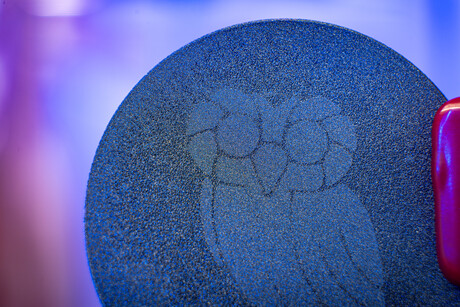
At Rice University, a research lab’s signature keepsake helped perfect a method for growing patterned diamond surfaces that could help decrease operating temperatures in electronics by 23°C.
Heat management is one of the major challenges facing today’s high-power technologies, from the gallium nitride transistors used in radar and 5G devices to the processing units powering the data centre infrastructure that supports artificial intelligence. Diamond outshines most other materials when it comes to handling heat, but its hardness makes it difficult to work with. Growing diamond in technology-relevant forms is also challenging.
“In the world of electronics, heat is the enemy,” said Xiang Zhang, assistant research professor of materials science and nanoengineering at Rice and a first author on a study published in Applied Physical Letters. “A reduction of 23°C is significant — it can extend the lifespan of a device and allow it to run faster without overheating.
“Most previous methods for shaping diamond use a ‘top-down’ approach, where they grow a full layer of diamond and then try to carve or etch it down,” Zhang added. “Because diamond is so hard and chemically resistant, that carving process is incredibly difficult, slow and can damage the material.”
The opposite ‘bottom-up’ approach prepares diamond patterns during the growth process itself, building the material literally from the ground up. In this case, Zhang and colleagues in the research group led by Pulickel Ajayan, a professor of materials science and nanoengineering, used a method known as microwave plasma chemical vapour deposition.
“It entails a reactor that uses microwave energy — like in your kitchen but much more powerful — to turn gas into plasma,” Zhang said. “This plasma breaks down carbon-heavy gases mixed with hydrogen, and the carbon atoms rain down and settle onto your substrate.”
The process by which the pulverised cloud of carbon atoms assembles into an ordered layer of diamond crystals on a given substrate is called nucleation.
“Nucleation is like planting seeds,” Zhang said. “Diamond crystals don’t just appear out of nowhere. They need a starting point to latch onto. Nucleation is simply the process of providing that initial foothold that allows the crystals to start growing.”
To control seed placement, the team used two techniques. For small, detailed patterns, they relied on photolithography, a standard method in microelectronics that entails coating substrate wafers with a light-sensitive material, partly exposing them to light to ‘set’ the coating, then washing away any remaining uncured material.
“Think of this as using light to create a precise stencil,” Zhang said. “What is left is a mold for our diamond seeds. So once the substrate wafers are prepped, we spread a liquid containing nanodiamonds over their surface. These tiny specks act as the starters for the diamond growth.”
For larger wafers, the process needs a different approach. A commercially available film is first laminated onto the wafer, then a laser cuts the desired pattern into the film. The unwanted sections are peeled away, and diamond seeds are applied across the surface. Once the rest of the film is peeled off, all that’s left is a clean, patterned template for diamond growth obtained without harsh chemicals or complex processing.
“This approach allowed us to scale up to a full 2-inch wafer,” Zhang said.
The seeded wafers are then placed in the microwave plasma reactor and showered with carbon atoms that settle onto the seeds, building solid diamond layer by layer.
The new method allows researchers to control not just where diamond grows but how it grows. By adjusting seeding density, they can influence crystal size and structure within a single pattern. As proof of concept, the study tested silicon and gallium nitride substrates, but the method could also be applied to other base layers.
“The main takeaway is that we have found a scalable, effective way to integrate diamond cooling into electronics,” Ajayan said. “This matters because heat is what limits the battery life of your phone and the speed of your computer. By using diamond to cool these devices more efficiently, we can pave the way for faster, more reliable and longer-lasting technology.”
“This work demonstrates wafer-scale, selective diamond growth compatible with heterogeneous integration, enabling high-performance thermal management at device-relevant temperatures and layouts,” Zhao said.
Zhang added that the idea to grow diamond into intricate shapes — including an owl, the university’s mascot — was prompted by wanting to have a special keepsake to give to distinguished guests. He experimented with several different methods over a short period before eventually developing this specific technique for large-scale diamond growth.
“We originally viewed these patterns, such as the diamond owl, more as pieces of scientific art or decoration rather than functional device components,” Zhang said. “Now, we have translated these artistic techniques into a functional application for the thermal management of electronics. It is incredibly satisfying to be a conduit for this kind of exchange between art making and science.”
Next steps involve perfecting the interface between diamond and other materials to facilitate the development of next-generation high-power semiconductor devices such as high-electron-mobility transistors.
Novel semiconductor device enables low-voltage switching
A gallium oxide-based semiconductor device has demonstrated 0.8 V switching, marking a step...
Neuromorphic chip combines sensing, memory and processing
A new neuromorphic vision chip integrates sensing, memory and processing in one system, enabling...
Cyborg cockroaches carry electronics into disaster zones
UQ researchers have equipped cockroaches with lightweight electronics, cameras and injectors,...