
Fuel cell catalyst targets data centre energy needs
The explosion of new data centres being proposed and built around the world has increased demand for energy to keep them powered and cooled.
Now, a team of researchers, led by Gang Wu, the Elvera and William R. Stuckenberg Professor in the McKelvey School of Engineering at Washington University in St. Louis, has made strides towards making a better low-temperature fuel cell that could allow renewable energy to relieve some of the burden on electricity or on fuel for transportation. Collaborators include teams from Brookhaven National Laboratory, Lawrence Berkeley National Laboratory, Northeastern University and the University of Pittsburgh.
Results of their research have been published in Nature Nanotechnology.
“If a data centre is able to supply its electricity itself by using a fuel cell, it would directly convert hydrogen and other fuels into the electricity, reducing the burden on the energy grid,” Wu said.
Fuel cells efficiently combine hydrogen and oxygen to create electricity, water and heat with the help of a catalyst to speed the process, reduce energy loss and improve overall performance and long-term durability. The challenge is designing catalysts for fuel cells, which still lack the adequate activity and durability needed to meet performance targets.
Platinum, a precious metal, is the most desirable catalyst. The goal is to use as little as possible while still providing sufficient catalytic performance during energy conversion and storage. Converting bulk platinum into nanoparticles greatly increases its exposed surface area, allowing very small amounts, typically less than one-quarter of a milligram per square centimetre. Unfortunately, nanoparticles can dissolve, migrate and grow during fuel-cell operation, gradually reducing performance.
Recently, emerging platinum intermetallic catalysts have shown promise in improving catalyst activity and stability compared to conventional platinum alloys. To maintain a well-dispersed nanoparticle morphology and maximise platinum utilisation, most of them are currently synthesised during annealing at temperatures below 700°C. However, the temperature is not high enough to drive the complete order–disorder transition, a critical process for improving the activity and stability of intermetallic catalysts.
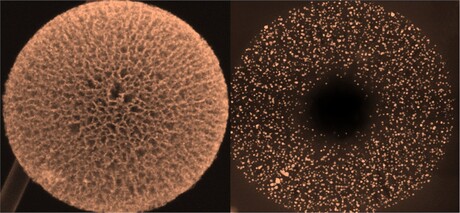
Wu and his group addressed this longstanding trade-off by developing a new nanostructured carbon featuring porous, hollow carbon spheres with ordered radial nanochannels and ample porosity and surface area. The unique carbon can assemble highly dense and well-dispersed platinum–cobalt intermetallic nanoparticles, thereby enabling the formation of the necessary intermetallic structure at desirable high temperatures while maintaining uniform nanoparticle dispersion. Their new approach overcame the challenging trade-off between how ordered the atoms were arranged in the intermetallic phase and how evenly the fine nanoparticles were spread out.
“Our strategy is using this new carbon nanostructure to synthesise platinum cobalt intermetallic nanoparticles that can reduce precious metal content and enhance activity and stability,” Wu said. “Traditionally, there would be a trade-off between size and stability, but with the ordered carbon nanochannel host, platinum cobalt nanoparticles can be confined and remain stable at very small particle size even at high temperatures.”
When researchers synthesise a larger particle, they sacrifice the activity for stability, while other efforts that focus on stability sacrifice activity. Wu’s team developed the innovative nanostructured carbon support with tiny channels arranged in a radial pattern and carefully controlled pore volume and size. It kept 85% of its performance after harsh 150,000-voltage cycles, likely equivalent to 25,000-hour operation, and overcame the challenging activity–stability trade-off by having larger pores, well-organised pore sizes and a high surface area.
“Because of this special carbon nanostructured support, we could heat the platinum–cobalt catalyst to 1000°C, which is high enough to form a very ordered structure while still keeping the nanoparticles smaller than 5 nanometres and well spread out, even with industry-preferred high content of platinum in catalysts,” Wu said.
“The open channel structure also helps the ion-containing material, such as an ionomer, spread evenly and makes it easier for protons, oxygen and water to move through the electrode,” Wu continued. “As a result, the platinum cobalt nanoparticles built into this support showed best-in-class performance and long-lasting durability. Eventually, through further development and collaboration with industry partners, we’ll be able to solve the remaining catalyst problems and significantly advance fuel cell technologies for powering our future more efficiently and sustainably.”
Wu has filed a patent on the technology through the WashU Office of Technology Management.
On-chip quantum memory enables longer photon storage times
Researchers have developed a chip-based quantum memory for longer-term photon storage.
Novel semiconductor device enables low-voltage switching
A gallium oxide-based semiconductor device has demonstrated 0.8 V switching, marking a step...
Neuromorphic chip combines sensing, memory and processing
A new neuromorphic vision chip integrates sensing, memory and processing in one system, enabling...


