How do you measure one-third of an electron?

An electron is supposed to be indivisible. It carries one fundamental unit of electric charge, and every electron is exactly the same.
But under extreme conditions, large numbers of electrons act together and give rise to new quantum objects called quasiparticles. These act as if they carry only a fraction of an electron’s charge, making them one of the strangest phenomena in modern physics.
Such extreme conditions occur during something called the “quantum Hall effect”: when electrons are confined to two dimensions and exposed to an intense magnetic field at very low temperatures, they stop behaving like individual particles and instead organise into highly ordered quantum states. In some of these states, the collective motion of many electrons gives rise to quasiparticles with fractional electric charges.
For years, researchers have relied on complex experiments to detect these fractional charges. Now, a team led by Mitali Banerjee, professor at the Laboratory of Quantum Physics, Topology and Correlations at EPFL, has shown that a much simpler graphene device can allow scientists to study electrons in many more states.
A tiny hill for quantum particles
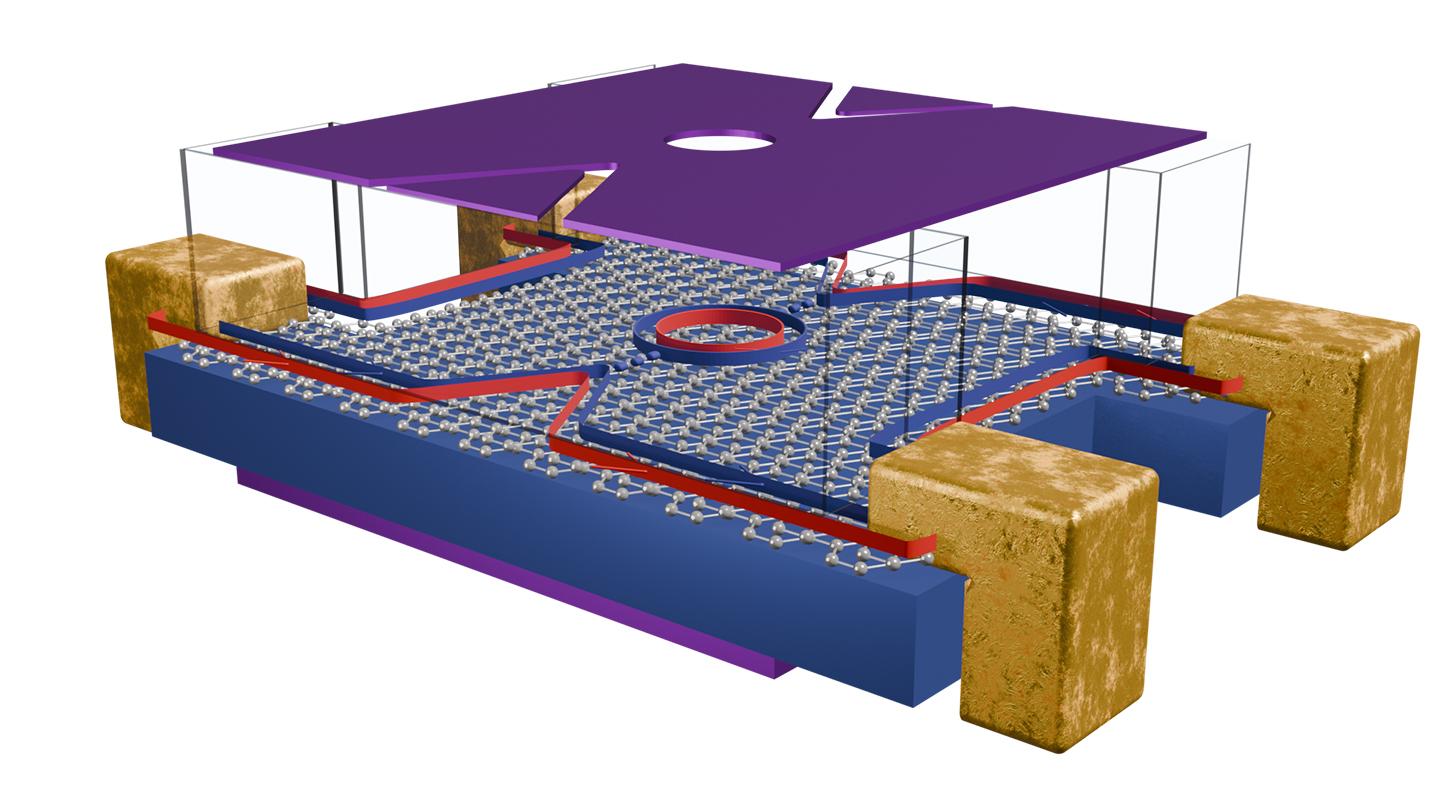
The device is built from bilayer graphene, a material made of two sheets of carbon atoms. Using an electrical gate, the researchers created a tiny energy hill called an antidot.
Quasiparticles move around this energy hill in well-defined paths. Changing the magnetic field or gate voltage causes them to tunnel across the device at regular intervals. Each tunnelling event produces a small oscillation in the electrical signal.
By measuring the spacing between these oscillations, the researchers can work out the charge of the quasiparticles. In other words, the antidot acts like an extremely sensitive charge meter.
Measuring impossible charges
The measurements revealed quasiparticles carrying one-third of an electron’s charge at several quantum Hall states, including the states 4/3, 5/3 and 7/3. The researchers also measured charges of two-thirds of an electron at 2/3 and three-fifths of an electron at 3/5.
The numbers 4/3, 5/3 or 7/3 describe different quantum Hall states, each corresponding to a distinct way that electrons collectively fill the available energy levels in a magnetic field. Some of these states are predicted to host quasiparticles with different fractional charges, which is what the new device measures.
One state, known as 8/3, behaved differently. There, the device showed signatures of both one-third and two-thirds electron charges. The researchers discuss several possible explanations for this unusual behaviour, including different edge structures and tunnelling mechanisms.
Quantum tech implications
Such fractionally charged quasiparticles are a defining feature of topological quantum matter, an unusual class of materials whose properties emerge from the collective behaviour of many particles rather than from individual atoms. Studying them helps physicists test fundamental ideas about quantum mechanics and understand exotic states of matter.
Some of these states are also being explored as possible building blocks for future quantum technologies. The new antidot design offers a practical way to investigate them. It is compact, electrically tuneable and relies on straightforward conductance measurements rather than the more elaborate techniques used in many previous experiments.
The researchers suggest that the same approach could be adapted to other two-dimensional materials, providing a simple way to study a wider range of exotic quantum states. “The same geometry could also be used as a building block to make a topological quantum computer,” said Mario Di Luca, the first author of the paper, published in Nature Physics.
Neural networks enable autonomous drone flight control
Scientists have created an autonomous racing drone using little more than a single forward-facing...
New form of magnetism could reshape future chips
Researchers have demonstrated experimental evidence of altermagnetism in a layered material,...
On-chip quantum memory enables longer photon storage times
Researchers have developed a chip-based quantum memory for longer-term photon storage.