On-chip quantum memory enables longer photon storage times
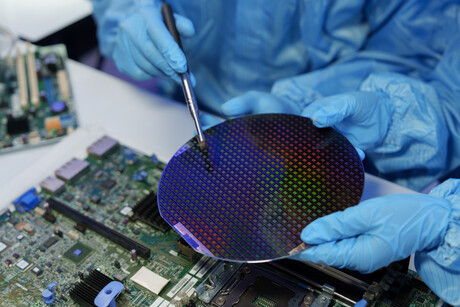
For fragile quantum information systems, the ability to store quantum information is vital, but also challenging.
Quantum information is transported in particles of light called photons, which often must be temporarily paused (or ‘stored’) while other, slower quantum operations catch up. This storage must be performed on microchips as small as one centimetre — a distance covered by light in a few trillionths of a second. Storing photons for a microsecond would represent a massive leap forward for the capabilities of quantum chips.
New research from The Grainger College of Engineering at the University of Illinois Urbana-Champaign addresses this challenge by developing an integrated on-chip nanophotonic platform for longer-term storage of photons. Led by physics professor Elizabeth Goldschmidt and published in Nano Letters, the group’s integrated platform leverages the versatility of spectral hole burning and the scalability of thin-film lithium niobate, giving it potential for scalable manufacturing, with implications for both classical and quantum photonics.
There are two broad ways to store photons. Using conventional photonics, a field that utilises macroscopic components like optical fibres and mirrors, scientists can delay light by extending its travel path, but this comes at a cost. Photons are easily absorbed by matter and traveling for longer distances increases the likelihood of absorption. A photon is unlikely to survive the distances required for quantum-relevant delays, making conventional photonic storage highly inefficient. Alternatively, photons can be coupled to highly coherent atoms for longer storage. However, integrating such atoms with scalable nanophotonic platforms is largely out of reach.
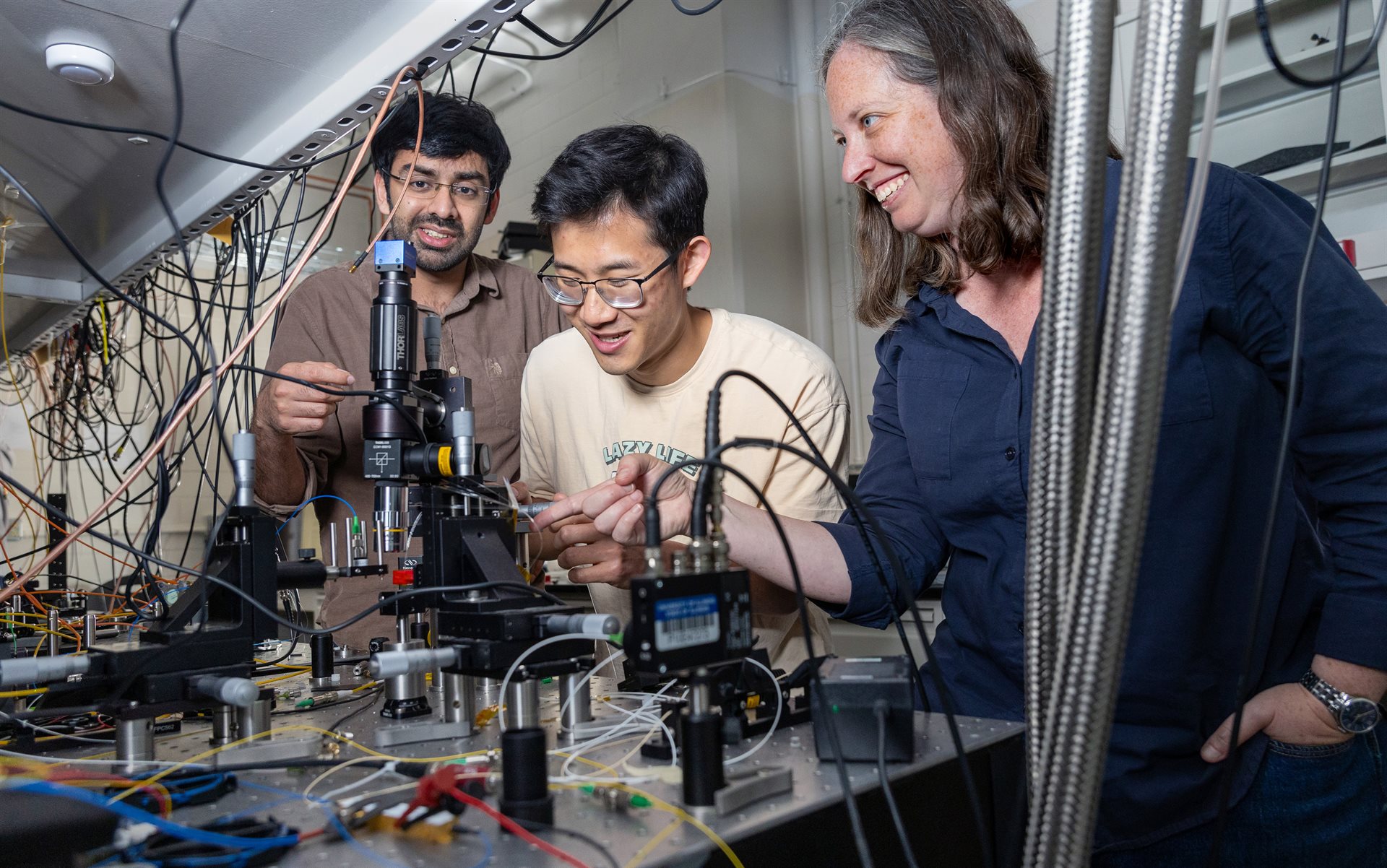
“Long delays are an outstanding problem in quantum information processing,” said Daren Chen, a physics graduate student and the paper’s co-first author. “We wanted to demonstrate a very promising approach for this using our nanophotonic platform.”
Members of Goldschmidt’s lab tackled the problem by building on previous work in rare earth-doped materials systems and spectral hole burning-induced slow light. The Illinois researchers fabricated a nanoscale waveguide made of thin-film lithium niobate (TFLN), a material known for its strong light confinement, low optical loss and wafer-scale integration, and doped with erbium atoms, which have desirable quantum properties.
A tuneable laser was used to spectrally arrange the atoms into a comb-like pattern with even spacing between each frequency peak. Known as an atomic frequency comb, this design enables the atoms to temporarily ‘catch’ and ‘hold’ incoming photons for a predetermined amount of time.
The resulting device demonstrated high-fidelity preservation of quantum information, with storage times exceeding 1 microsecond and the ability to store multiple photons at once. Most importantly, it has the potential for commercial scalability and is easy to replicate.
“This is not a one-off bespoke device. Its promise is in its simplicity: we’ve taken something that can typically only be done in a highly specialised laboratory environment and recast it in a platform that can be made commercially at scale by people who don’t know anything about quantum optics,” Goldschmidt said.
Goldschmidt sees the pioneering platform as a step towards integrating quantum memories into scalable, chip-based quantum computers and communication networks. A practical version of the device will need to demonstrate better retrieval efficiency and longer storage times — efforts the group will pursue by improving their frequency comb and experimenting with different erbium isotopes that are more impervious to noise.
Neural networks enable autonomous drone flight control
Scientists have created an autonomous racing drone using little more than a single forward-facing...
New form of magnetism could reshape future chips
Researchers have demonstrated experimental evidence of altermagnetism in a layered material,...
Novel semiconductor device enables low-voltage switching
A gallium oxide-based semiconductor device has demonstrated 0.8 V switching, marking a step...