Moiré ferroelectric pixels enable next-gen nanoelectronics
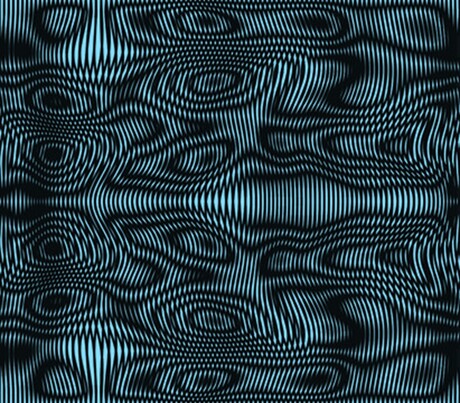
Just as swirly, wave-like patterns can appear on a computer screen when pixels do not align, new research led by Flinders University is investigating atomic-scale ‘moiré patterns’ in the promising field of ferroelectricity.
The new study, conducted with experts at Monash University and Nanyang Technological University in Singapore, seeks inroads into electrical and optical science by exploring these complex ‘superlattice’ patterns in various ways to create new energy and material capabilities.
“Similar to the pixel example, we can overlay single-atom-thin layers in non-aligned ways to achieve physical properties not present in regular repetitive materials — including superconductivity, special insulating and conductive states, and ferroelectricity,” said Dr Pankaj Sharma, from the Institute for Nanoscale Science and Technology at Flinders University.
“We do not fully understand how these structures behave, but early experiments reveal some unusual electronic and optical effects — suggesting that moiré ferroelectric materials could play an important role in future low-energy nanoelectronics and photonics applications.”
Alongside magnetism, ferroelectricity involves electrical charges within the metal material instead of magnetic poles. In certain materials, tiny electric dipoles line up to create an electric polarisation which can be switched around using an applied voltage.
The latest research, published in Small Structures, used advanced microscopy and other techniques to explore polarisation textures and the conditions under which they form in moiré materials.
Co-author Josh Edwards, a physics PhD student in the Sharma Lab, said the potential impact of carefully stacked thin layers on top of each other is significant.
“These tiny polar structures can respond very quickly to a range of external stimuli and could therefore potentially outperform similar magnetic structures that are currently being explored for computing technologies such as high-density memory and brain-inspired computing systems,” Edwards said.
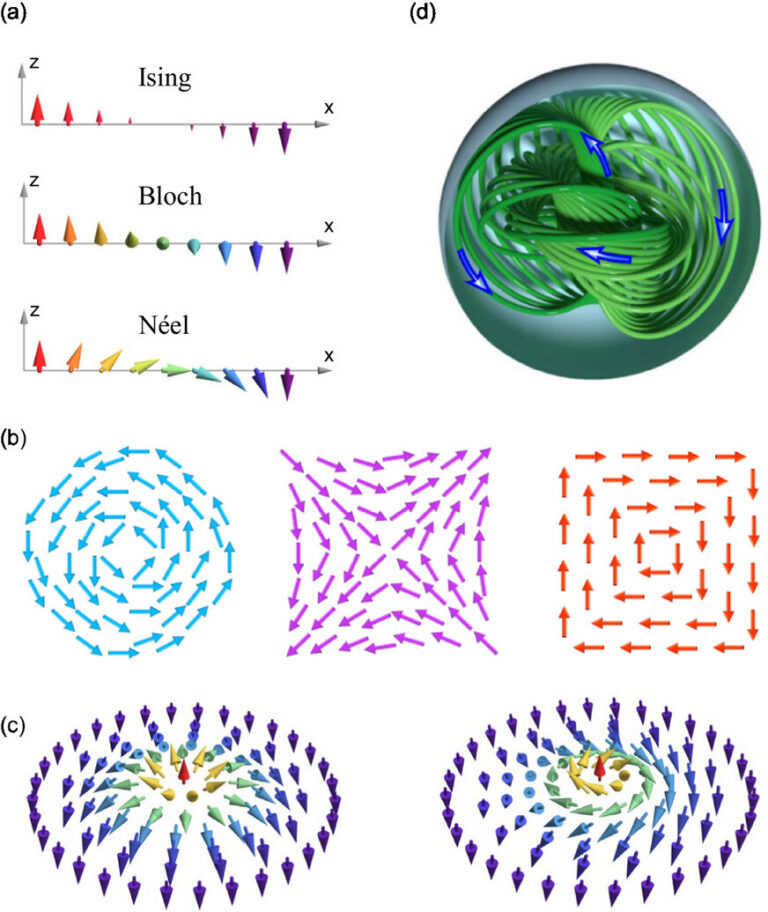
The new moiré materials also had the potential to be engineered to carry ferroelectricity and polarisation in many complex ways — both in the individual layers and chiral textures at nanoscale (see Figure below).
Electrical method could help detect extraterrestrial life
An AI-powered nanogap method can distinguish amino-acid forms, opening a path to compact...
Research identifies hidden network latency bottlenecks
Researchers have identified hidden network latency bottlenecks, revealing where delays occur and...
Optical isolators integrated on silicon photonics chips
A new laser-annealing process integrates optical isolators directly onto silicon photonics chips,...