Ultra-thin membranes enhance clean energy device performance
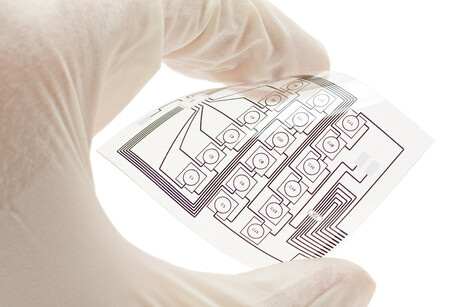
Researchers at The University of Queensland are harnessing an intricate building technique to produce hyper-thin-film membranes that boost the reliability, efficiency and lifespan of key clean energy systems.
Dr Zhuyuan Wang and Professor Xiwang Zhang from UQ’s School of Chemical Engineering said membranes that transport ions in fuel cells, batteries and electrolysers were often not strong enough to stand the harsh operating conditions.
“Strengthening these membranes, however, usually means trading off valuable electrochemical qualities, which affects the performance of devices they are used in,” Wang said.
“Our research shows that we don’t need to make that compromise.”
Wang and Zhang used a ‘nanoconfinement polymerisation strategy’ to control chemical bonding reactions within tiny, nanoscale channels.
“In such a tight space, the polymers have no room to grow in a messy way,” Zhang said.
“They are forced to pack neatly and tightly, which makes the membranes extra dense, very strong, and excellent at letting target ions pass through quickly and efficiently.”
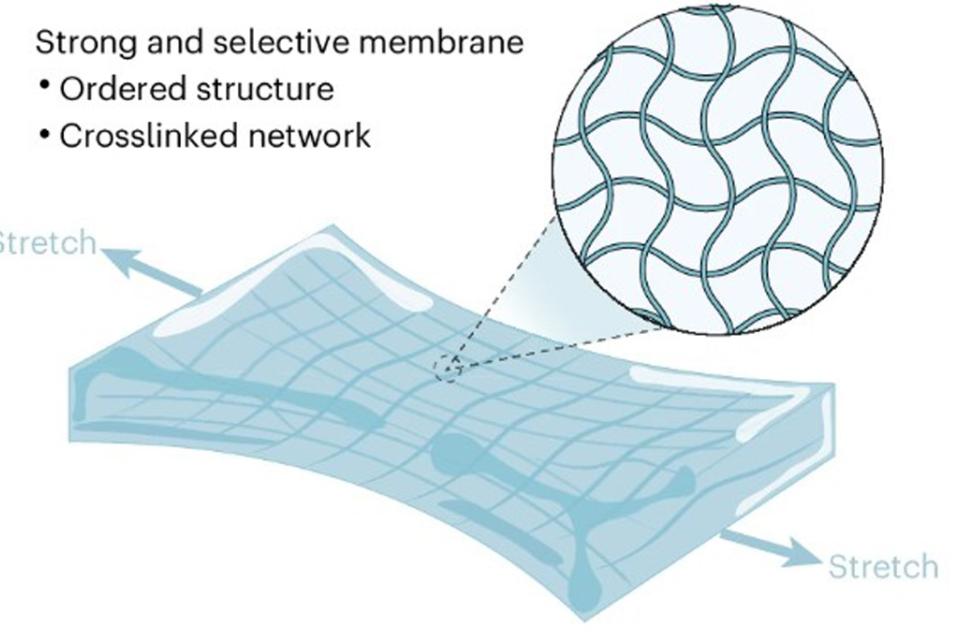
The membranes achieve roughly twice the tensile strength than conventional products while maintaining excellent flexibility and can be bent 100,000 times while maintaining mechanical integrity.
Crucially, researchers said this fabrication method can be applied to other thin-film technologies.
“The conductivity and selectivity of the new membranes outperform both commercial membranes and those reported in literatures, with an ion exchange capacity nearly 20% higher,” Wang said.
Wang said the next step would be encouraging research into how nanochannel polymerisation strategy can be adapted for scalable production.
“By tweaking how we make these small pieces of film we have the potential to improve the efficiency, power output and operational stability of a number of electrochemical devices for decarbonisation,” Wang said.
The research was published in Nature Synthesis.
Biohybrid mesh could power implantable electronics
A flexible biohybrid mesh integrates living human cells with piezoelectric materials to harvest...
Electrical method could help detect extraterrestrial life
An AI-powered nanogap method can distinguish amino-acid forms, opening a path to compact...
Research identifies hidden network latency bottlenecks
Researchers have identified hidden network latency bottlenecks, revealing where delays occur and...