OLED circular polarisation is now electrically switchable
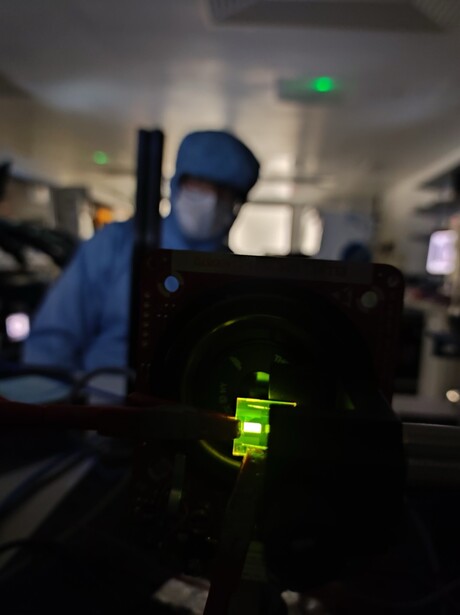
Researchers from the University of Oxford have discovered an approach to electrically switch organic LEDs (OLEDs) to emit either left- or right-handed circularly polarised light without changing the light-emitting molecules. This could be useful for a range of technological applications, from more energy-efficient OLED displays, to optical information transfer. They describe their results in a study published in Nature Photonics.
Usually, the handedness of such circularly polarised light from LEDs is controlled by choosing a particular mirror image form of the light-emitting molecule within the device. These mirror image forms are referred to as left- or right-handed, or chiral, which can be thought of as similar to choosing whether a corkscrew twists to the left or to the right. The handedness of the molecule controls the handedness of the emitted light. This necessarily requires access to both mirror image forms of the molecule, which are complex and expensive to prepare.
Now, researchers from the University of Oxford have shown that both left- and right-handed forms of circularly polarised light can be produced by just one mirror form of the molecule in an OLED.
The researchers managed to switch the handedness of the emitted light electrically, without changing the material itself. They achieved this by designing emitting materials that show unusual effects on circularly polarised light, together with careful control of the way the electronic charges recombine inside the device. Depending on whether charge transport is balanced or unbalanced, the device produces one or the other mirror form of circularly polarised light. Key to this unexpected outcome is the use of an organic polymeric emitting material in the device that self-assemblies into a highly twisted structure.
Controlling light polarisation is of particular interest for current and future technologies, including low-power displays, encrypted communications and high-performance quantum applications. “Adding circular polarisation allows for additional information to be encoded into the light signal,” said Professor Matthew Fuchter, the lead author of the study. “Rather than your signal being simply on or off, it could additionally be on-and-left or on-and-right.”
Previous methods of controlling OLED light circular polarisation relied on separating differently handed forms of the same molecule, a process which is laborious, expensive and poorly scalable. This new approach therefore provides a paradigm shift in creating circularly polarised LEDs with controllable circular polarisation.
Excitingly, the team’s study demonstrates new fundamental links between molecule chirality and light chirality, commonly called optical activity. The team hopes that this insight into the physics of chiral organic materials will lead the way to new applications in areas such as advanced displays, secure communication systems and quantum technologies.
Plasma beam antenna transmits radio waves with lasers
A new plasma beam antenna uses laser-generated plasma to transmit radio waves, potentially...
Degrading dopants could enhance semiconductor performance
A new doping method produces up to 100 times more mobile charges in organic semiconductors,...
Nanoscale polar whirlpools emerge in atom-thin semiconductors
Tiny polar whirlpools found in atom-thin tungsten diselenide could enable new approaches to...