Red OLED microdisplay for energy-efficient AR/VR
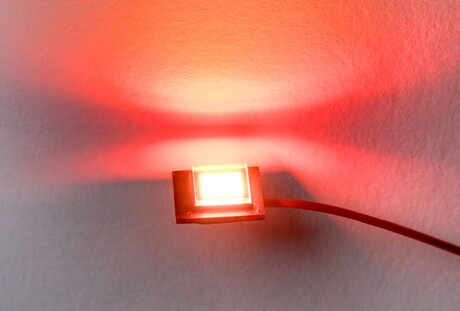
Scientists at the Fraunhofer Institute for Photonic Microsystems (IPMS) have developed a red OLED microdisplay that is both exceptionally bright and highly efficient.
OLED microdisplays are characterised by their compact design, sharp presentations and low energy consumption, making them ideal for wearable technologies. The latest microdisplay from Fraunhofer IPMS raises the brightness of such systems to a new level. It allows for the display of changing full-graphic symbols, which not only improves precise alignment but also facilitates optical assembly.
Like all other microdisplays from the institute, this new display is based on standard CMOS semiconductor processes, with a silicon backplane serving as the foundation for the OLED technology.
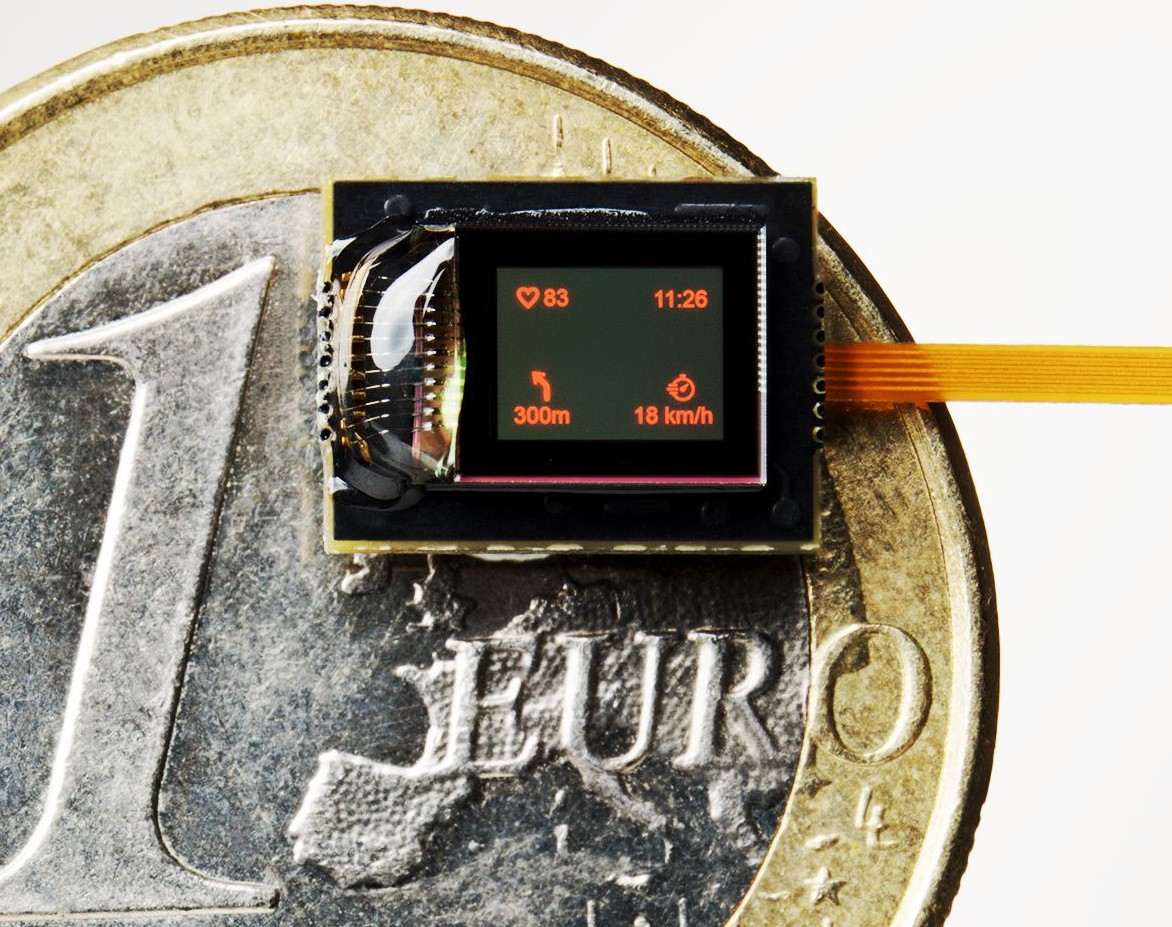
“The new red OLED microdisplay achieves impressive brightness levels of 35,000 cd/m2 while consuming very little power,” said Uwe Vogel, division director of microdisplays and sensors at Fraunhofer IPMS. “Thanks to our ultra-low-power technology, only the necessary pixels are changed for the next image instead of updating the entire image, which saves a tremendous amount of power.”
The high brightness now enables use in data glasses and helmets under daylight conditions. This was achieved through a newly developed OLED stack with highly efficient materials, allowing previously unattainable brightness for red OLEDs.
Moreover, the new OLED stack can be transferred to various backplane formats. The scientists at Fraunhofer IPMS are looking forward to customer- and application-specific developments of these new microdisplays, marking another important step in the evolution of display technology.
Plasma beam antenna transmits radio waves with lasers
A new plasma beam antenna uses laser-generated plasma to transmit radio waves, potentially...
Degrading dopants could enhance semiconductor performance
A new doping method produces up to 100 times more mobile charges in organic semiconductors,...
Nanoscale polar whirlpools emerge in atom-thin semiconductors
Tiny polar whirlpools found in atom-thin tungsten diselenide could enable new approaches to...