Steering light with magnets
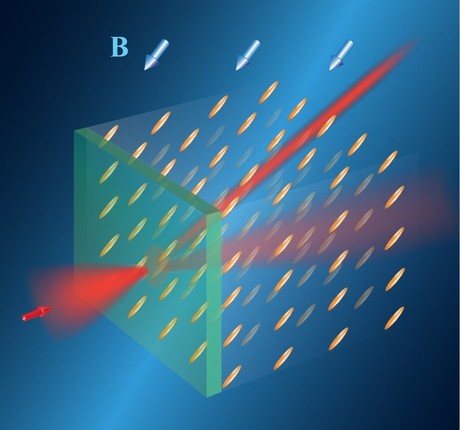
Researchers from The Australian National University (ANU) have used magnets to steer light, opening the door to communications systems which could be smaller, cheaper and more agile than fibre optics.
Today’s communication technologies aim to maximise data transmission rates and require the ability to precisely direct information channels. These technologies use electronic components for signal processing such as switching, which is not as fast as light-based technology such as fibre optics.
Seeking a new way to steer light beams carrying data, Professor Wieslaw Krolikowski and his team looked to nematic liquid crystals. Writing in the journal Nature Communications, the researchers stated, “Among photofunctional materials that can be employed to control the propagation of light by modifying their properties, soft dielectrics such as nematic liquid crystals (NLCs) stand out for their large all-optical response.”
“In the liquid crystal the light creates a temporary channel to guide itself along, called a soliton, which is about one-tenth the diameter of a human hair. That’s about 25 times thinner than fibre optics,” said Dr Yana Izdebskaya, a co-researcher on the project.
“Developing efficient strategies to achieve the robust control and steering of solitons is one of the major challenges in light-based technologies.”
Dr Izdebskaya said controlling solitons in liquid crystals has until now only been achieved by applying voltage from inflexible electrodes. The ANU team approached things differently by using a magnetic field to stimulate the NLCs, successfully modifying their properties in the process.
“[Previous] systems have been restricted by the configuration of electrodes in a thin liquid crystal layer,” Dr Izdebskaya said. “Our new approach doesn’t have this limitation and opens a way to full 3D manipulations of light signals carried by solitons.”
Co-researcher Dr Vladlen Shvedov added that the innovation promises a much more agile system than fibre optics. “This touch-free magneto-optical system is so flexible that you can remotely transfer the tiny optical signal in any desired direction in real time,” he said.
Professor Krolikowski said the breakthrough will be crucial for developing tiny components to process huge amounts of data. It could therefore go on to power communication technology including optical switches, routers and modulators, as well as sensors, data storage systems and liquid crystal displays.
Plasma beam antenna transmits radio waves with lasers
A new plasma beam antenna uses laser-generated plasma to transmit radio waves, potentially...
Degrading dopants could enhance semiconductor performance
A new doping method produces up to 100 times more mobile charges in organic semiconductors,...
Nanoscale polar whirlpools emerge in atom-thin semiconductors
Tiny polar whirlpools found in atom-thin tungsten diselenide could enable new approaches to...