
Diamond sensor reveals hidden magnetic fluctuations
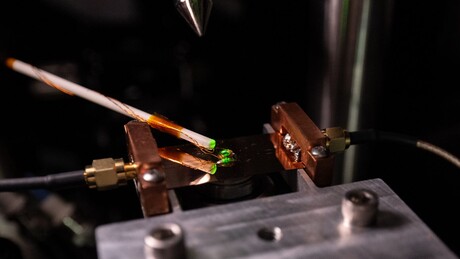
In spaces smaller than a wavelength of light, electric currents jump from point to point and magnetic fields corkscrew through atomic lattices in ways that defy intuition. Scientists have only ever dreamed of observing these marvels directly.
Now Princeton researchers have developed a diamond-based quantum sensor that reveals new information about magnetic phenomena at this minute scale. The technique uncovers fluctuations that are beyond the reach of existing instruments and provides key insight into materials such as graphene and superconductors. Superconductors form the basis of hoped-for technologies like lossless powerlines and levitating trains.
The underlying diamond-based sensing methods have been under development for half a decade. But in a paper in Nature, the researchers reported roughly 40-times greater sensitivity than previous techniques.
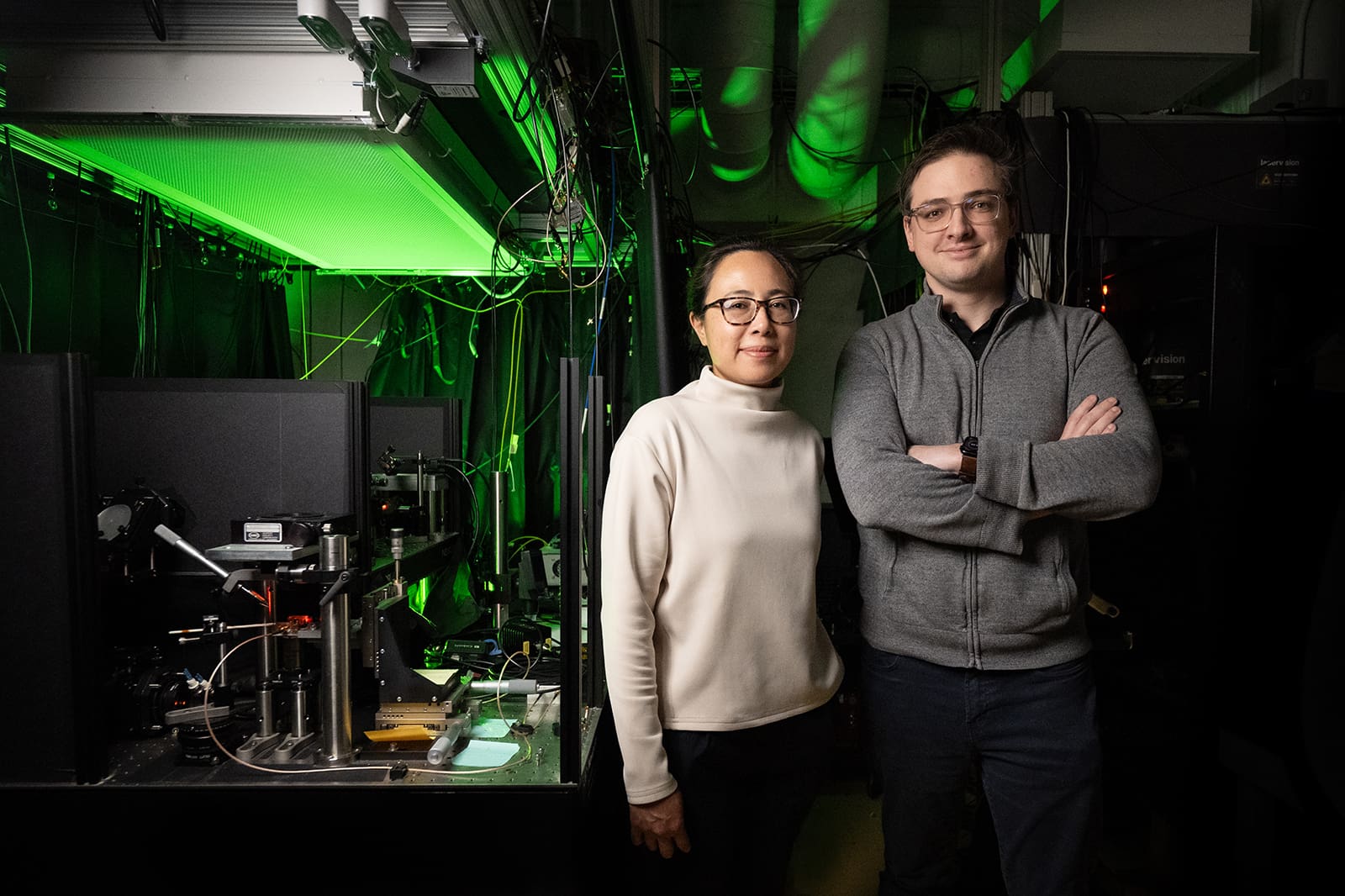
Nathalie de Leon, associate professor of electrical and computer engineering and the paper’s senior author, said the new technique gives researchers a way to directly observe the structure of “very small magnetic fields and very small length scales”. That reveals details about magnetic fluctuations that hide in the statistical data of more conventional approaches.
“You have this totally new kind of playground,” de Leon said. “You just can’t see these things with traditional techniques.”
A new way to study real quantum materials
Her team’s new technique is based on engineered defects near the surface of a lab-grown diamond. These diamonds, about the size of a large flake of sea salt, are far purer than natural diamonds and the defects engineered into them are vanishingly small — one missing atom in a lattice of billions. But because those defects interact strongly with magnetic fields, and because they can be carefully engineered, they make excellent magnetic sensors.
Typically, these sensors are treated as individual points in space. In this latest advance, de Leon and her team built a system that implants two of these defects extremely close together, allowing the defects to interact in quantum-mechanical ways that, to the researchers’ surprise, made the overall system much more capable.
“That is a very new way of operating this quantum sensor that allows us to probe something which has not been possible before,” said Philip Kim, an experimental physicist at Harvard who was not involved in this study. Other techniques that try to get at this information have been confined to carefully constructed arrays of atoms, not real materials, Kim said. The new technique allows scientists to probe real materials directly.
Kim is now working with de Leon using complementary techniques in his lab, where he studies condensed matter physics. Specifically, he looks at superconductors that can be cooled by liquid nitrogen to their critical temperatures, and graphene, a material that has proven difficult to engineer at scale.
Quantum entanglement reveals signals in the noise
To create the new sensor, the researchers fired nitrogen molecules travelling more than 30 thousand feet per second at the diamond. When a molecule strikes the diamond’s famously hard surface with that much energy, the molecule breaks apart, sending its two nitrogen atoms — no longer chemically bonded — hurtling in separate directions into the diamond’s crystalline structure.
By precisely controlling how much energy the molecule has when it slams into the diamond, the researchers can control how deep the nitrogen atoms penetrate. In this case, they drill past a few dozen carbon atoms and stop about 20 nanometres beneath the surface, coming to rest roughly 10 nanometres apart from each other. That exceedingly small separation allows the two atoms to interact with each other in ways that give rise to quantum entanglement.
When entangled, the electrons in these two nitrogen atoms begin to act in lockstep. The measurement of one reveals a perfectly correlated measurement in the other. Because they still represent distinct points, like two eyes, the entangled sensors can triangulate signatures in the noisy fluctuations and effectively home in on the source of the noise.
At this size range, between the atomic scale and the wavelength of visible light, de Leon said scientists want to measure previously invisible quantities, like how far an electron travels through a material before bouncing off another particle, or the evolution of magnetic vortices that appear in superconducting materials under special conditions.
“That range is, in fact, the length scale of interest,” Kim said. “A good range where one can understand a lot of interesting things.”
A weakness in the sensor leads to quantum advantage
The breakthrough that led to this entangled sensor came from Jared Rovny, who began working with de Leon in 2020 as one of the inaugural Princeton Quantum Initiative postdoctoral fellows.
The COVID-19 pandemic had curtailed access to the lab when Rovny started. So, like many of his peers, he set to work on ideas that did not require in-person, experimental set-ups. He and de Leon decided to dig into the theory around magnetic noise and see if there were ways to use the diamond defects — called nitrogen vacancy centres — to detect correlations in the magnetic noise that hums in the background of condensed matter physics.
“It started as one of these weird, COVID, theory projects,” de Leon said. At the time, sensing correlations in magnetic noise was not a topic of scientific conversation, she said. In fact, they started the project out of pure curiosity, not sure where it would lead. “It was only after we started formalising it that we realised how powerful it was.”
Rovny had a background in nuclear magnetic resonance, or NMR, in which interacting particles and their correlations were key to his research. This fed his curiosity and allowed the project to take a more serious turn.
“That NMR side of me was really always thinking about interactions,” Rovny said. “There were a bunch of different physics ideas I wanted to explore that had to do with interacting these things, not leaving them separate.”
At first, working in collaboration with Shimon Kolkowitz, an atomic physicist at University of Wisconsin-Madison (now at University of California-Berkeley), they looked at correlations between two centres that were not entangled. While those methods led to interesting findings, they were also technically onerous and prohibitively complex for most experimental uses.
“What I realised is that if you entangled them,” Rovny added, referring to the nitrogen vacancy centres, “the presence or absence of a correlation sort of puts its fingerprint onto the system”.
That fingerprint allowed them to bypass the most cumbersome problems and gave them the advantage of two sensors with roughly the same cost of using only one.
“Now all I have to do is a single measurement,” de Leon said, “a single normal measurement.”
Sapphire strain could reshape neuromorphic electronics
Argonne’s Advanced Photon Source X-ray beams reveal unexpected behaviour of a thin film...
Wallpaper generates electricity from moisture in the air
Printable moist-electric generators embedded in wallpaper could harvest indoor humidity to...
New benchmarks for quantum error correction
Researchers from the University of Sydney have found ways to reduce quantum measurement errors,...


