Novel semiconductor design may improve solar cell efficiency

Solar energy currently faces a critical limitation: materials that absorb light more strongly also tend to be less efficient at turning captured light into electricity.
Solar cells rely on materials called semiconductors, which absorb sunlight and use its energy to free tiny negatively charged particles called electrons, leaving behind positively charged gaps known as holes. To produce electricity, these charges must be collected before an electron and a hole meet and cancel each other out, wasting the energy they carry.
This creates a fundamental challenge. Semiconductors that absorb light more strongly also tend to lose their charges more quickly. This trade-off limits how efficiently solar cells can turn sunlight into electricity.
In a new study, researchers have discovered that bismuth sulfide appears to side-step this trade-off. This is because it has an unusual arrangement of energy levels that allows it to absorb light strongly while losing its electrical charges more slowly, pointing to a new way to design more efficient solar cells.
“One of the longstanding challenges in developing efficient solar-energy materials is that the properties which make a semiconductor very good at absorbing sunlight also tend to make the resulting electrical charges disappear quickly,” said corresponding author Professor Laura Herz (Department of Physics, University of Oxford). “Our work shows that this trade-off is not inevitable. By uncovering how an unusual electronic structure can combine strong light absorption with much slower recombination, we have identified a new principle for designing semiconductors that could help us harvest solar energy more efficiently.”
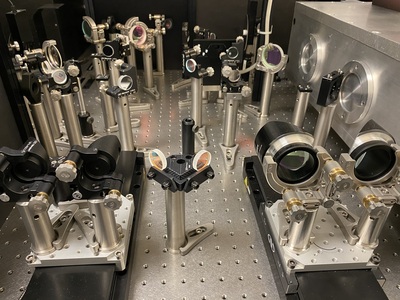
The team excited thin films of bismuth sulfide with extremely short laser pulses and then measured how quickly the resulting charges disappeared, using a technique called ultrafast terahertz spectroscopy. They carried out the measurements at temperatures ranging from room temperature to just above absolute zero.
Electronic structure calculations by Professor Marina Filip’s group in the Department of Physics revealed what makes the material unusual. It absorbs light mainly through one strong route between energy levels, but just below this in energy lies a second, much weaker route, through which charges are lost only slowly. The two are so close in energy that charges spend much of their time in these lower-energy states, which act as a temporary ‘reservoir’ and slow their loss.
The experiments confirmed this picture. In most semiconductors, charges are lost faster as the material is cooled, but in bismuth sulfide they were lost more slowly, as more charges settled into the reservoir. This matched the team’s model of what physicists call a pseudo-direct semiconductor. The team estimates that, at room temperature, this arrangement cuts the rate at which charges are lost by about 75% compared with conventional materials that absorb light as strongly.
For solar energy, this could matter in two ways. Charges that last longer have more chance of being collected, which could reduce one of the fundamental energy losses in solar cells without sacrificing strong light absorption. Longer-lived charges could also allow more time for the chemical reactions needed to turn sunlight into fuels.
The team’s calculations suggest that other materials with the same property could be found by screening materials databases, or engineered. The researchers stress that the study demonstrates a physical mechanism rather than a finished solar cell. Further work is now needed to translate these findings into improved solar cell technologies.
Multiferroics could enable low-power microchips
Ultra-thin multiferroic films could enable more energy-efficient AI microchips by preserving key...
Sapphire strain could reshape neuromorphic electronics
Argonne’s Advanced Photon Source X-ray beams reveal unexpected behaviour of a thin film...
Wallpaper generates electricity from moisture in the air
Printable moist-electric generators embedded in wallpaper could harvest indoor humidity to...