Polymer binder advances sustainable battery design
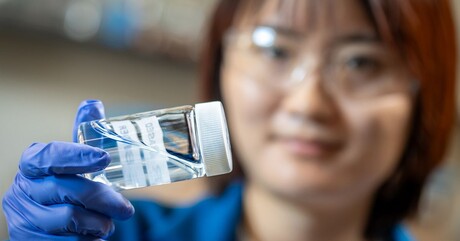
A new battery binder — the glue that holds together a battery’s internal parts — could make lithium-ion batteries more environmentally friendly and easier to recycle without sacrificing performance.
By creating a binder that is fluorine free and dissolves in water, engineers at the University of California San Diego showed that they can simplify both battery manufacturing and recycling by cutting down on toxic ingredients, energy use and waste. Batteries made with the new binder performed just as well as conventional lithium-ion batteries.
The advance, published in Nature Communications, was a collaboration between the lab of Zheng Chen, professor in the Aiiso Yufeng Li Family Department of Chemical and Nano Engineering at the UC San Diego Jacobs School of Engineering, and John Muldoon at Toyota Research Institute of North America.
The binder is the glue-like material that gets mixed with electrode powders to form solid layers, which are then stuck to thin metal foils inside the battery. These layers are stacked and rolled to create a battery. Although the binder makes up a small fraction of a battery’s weight, it has a big impact on how the battery is manufactured and recycled.
Lithium-ion batteries typically use a fluorine-containing binder because it produces strongly adhesive, uniform electrodes that remain stable throughout numerous charging and discharging cycles. That enables batteries to perform better and last longer.
“But that same stability also makes batteries much harder to recycle,” Chen said.
The problem with fluorine in binders
A fluorine-containing binder must be dissolved in a toxic solvent before it can be mixed with the electrode powders. After the electrodes are coated, large drying ovens are used to evaporate the solvent. Extra steps are then needed to recover and purify the solvent so it can be reused. “Those extra steps significantly increase the cost and energy use — as well as the environmental impact — of battery manufacturing,” said Jiao Lin, a postdoctoral researcher in Chen’s lab.
Fluorine-containing binders also complicate the battery recycling process. These binders leave behind stubborn residues that need high heat or corrosive chemicals to be removed. That, in turn, creates hazardous waste, as well as fluorine-containing by-products that contaminate the recovered battery materials and make them harder to reuse in new batteries.
After the binder is mixed with electrode powder, it forms a thick slurry that will be used to make an electrode layer.
No more fluorine or toxic solvents
To solve both problems, Chen’s team created a binder that contains no fluorine and can be processed using a non-toxic solvent: water. While other water-soluble binders already exist, they lack the strength and durability needed for high-performance batteries, Chen explained.
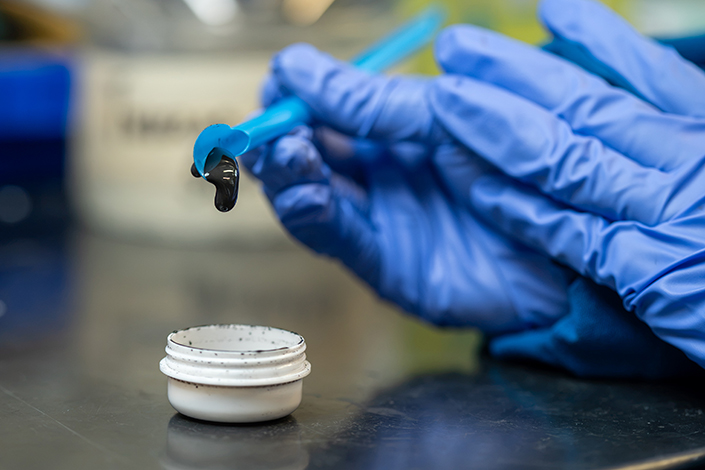
The new binder is made from two inexpensive and widely used polymers. Polyacrylic acid helps the mixture spread evenly during manufacturing and provides flexibility. Meanwhile, carboxymethyl cellulose, a plant-derived material commonly used in foods and paper products, provides strength and stickiness.
The polymers were first dissolved in water. Then, researchers added citric acid, the naturally occurring acid found in citrus fruits, to chemically link the polymers together. The result is a tightly connected network held together by various types of chemical bonds that reinforce one another. That gives this binder the strength, flexibility, stability and adhesion needed to rival conventional fluorine-containing binders.
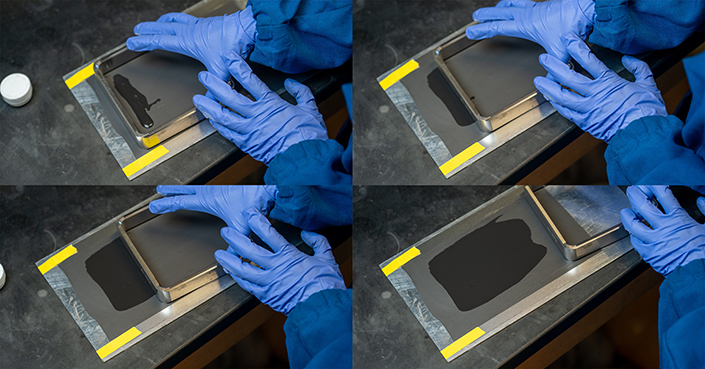
Making and recycling batteries with the new binder
Batteries built with the new fluorine-free binder delivered the same initial performance as conventional lithium-ion batteries. They even maintained their capacity longer after hundreds to thousands of charge cycles. The binder was also compatible with different types of electrodes, including lithium iron phosphate (LFP) cathodes, nickel-rich cathodes, graphite anodes and silicon anodes.
The new binder could also simplify battery recycling. Instead of using harsh chemicals and high temperatures to remove it, as is done with fluorine-containing binders, the researchers simply disassembled the battery and soaked the electrodes in water. This dissolved the binder and allowed the electrode coatings to cleanly separate from the metal foil sheets without leaving behind residues. The recovered electrode materials were then regenerated using direct recycling processes and used to build new batteries.
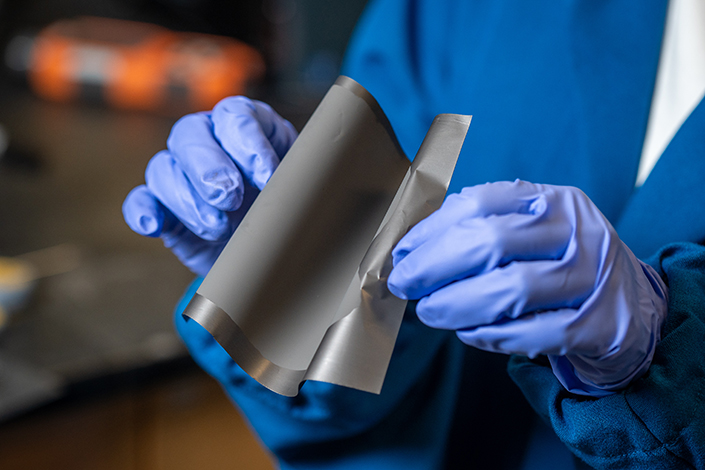
These recycled batteries performed just as well as ones built from electrode materials that were recovered from batteries made with conventional fluorine-containing binder.
Next steps include scaling up production of the binder for commercial manufacturing. The researchers are now working on optimising the binder for different battery chemistries to improve their performance. Chen and his team plan to commercialise the binder through collaboration with industry partners.
Bypassing weak cells could extend EV battery pack lifespan
Reconfigurable EV battery packs could last longer by bypassing weaker cells, with modelling...
Perovskite solar cells take flight for testing in space
Next-gen perovskite solar cells are heading into space aboard the CRIMSON-1 satellite, where...
Perovskite thin film powers devices using indoor light
Researchers have improved perovskite thin films, helping indoor photovoltaics capture light while...