3D-printed battery component enables custom cell designs
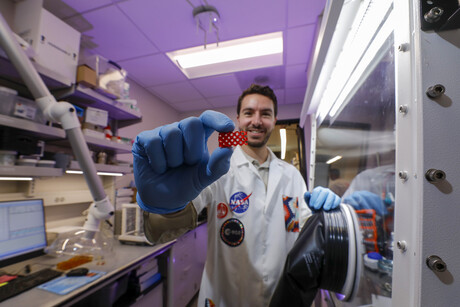
A team of researchers at The University of Texas at El Paso has developed a way to 3D-print an essential battery component in nearly any shape. Their innovation could free engineers from the constraints of standard rechargeable battery sizes and allow energy storage to be built directly into the devices the batteries power.
The work, detailed in a study published in Communications Engineering, is about gel polymer electrolytes, the material inside a battery that carries the ions (the particles which carry the electrical charge) between the electrodes (the two terminals where chemical reactions occur and electricity enters or leaves the battery).
Conventional electrolytes are liquids that must be sealed inside rigid casings, a design that limits battery shapes and raises safety concerns about leaks. The UTEP team created a printable gel by combining a light-curable resin with a lithium-based liquid electrolyte, then hardened it layer by layer using a technique called vat photopolymerisation.
The printed material performed on par with electrolytes made by conventional methods, reaching ionic conductivities of up to 3.4 x 10⁻³ siemens per centimetre, close to the performance of the liquid electrolytes it could replace. The researchers also pinpointed an optimal recipe, a one-to-four ratio of resin to electrolyte, that balanced strong electrochemical performance with clean, reliable printing.
Just as important for real-world use, the team printed the electrolytes in ordinary laboratory air rather than inside a sealed, oxygen-free chamber, and the material kept its performance. To demonstrate the design freedom the method offers, the researchers printed simple discs, an open honeycomb lattice and a solid one-centimetre cube, illustrating how future batteries could be shaped to fit a wearable, a medical device or an aerospace part rather than forcing the device to accommodate the battery.
“For years, the shape of a battery has dictated the shape of the device it powers,” said Alexis Maurel, PhD, the study’s lead researcher. “We are showing that you can print a high-performing electrolyte battery component with any shape and place it almost anywhere you want. That changes what designers are able to imagine.”
The work also clarified how the choice of solvent shapes both printability and battery behaviour, a question the authors note had gone largely unexamined in earlier research on printable electrolytes. One formulation proved especially stable during repeated testing, helping the team identify the most promising path forward.
The research was led by UTEP scientists in collaboration with Sandia National Laboratories. The team plans to refine its formulations and work towards incorporating these printed electrolytes into complete battery cells.
Smarter charging boosts lithium–tellurium battery performance
An optimised charging strategy could improve lithium–tellurium battery performance by...
Flexible porous material may improve solid-state batteries
A flexible porous material could address contact issues in solid-state batteries, potentially...
X-ray spectroscopy could enable longer-lasting batteries
X-ray spectroscopy and computer modelling offer a faster way to predict chemical interactions and...