Inkjet-printed photograph is also a solar cell
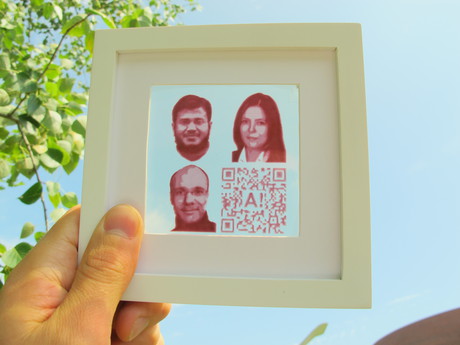
Researchers have successfully created inkjet-printed photographs that produce energy, paving the way for electrical devices to be powered by graphics and imagery on their surfaces. The Aalto University researchers inkjet-printed a solar cell in the form of a photograph and QR code.
While researchers have been printing solar cells for some time, they have traditionally only been black, because the darker the colour of the photovoltaic ink, the more electricity is produced. These researchers posited that a coloured inkjet-printed solar cell could still produce energy, while the printing could serve the dual purpose of creating power and conveying a message about the product in the form of text or an image.
“We wanted to take the idea of printed solar cells even further, and see if their materials could be inkjet-printed as pictures and text like traditional printing inks,” said lecturer Janne Halme.
The researchers had the idea that a colourful, patterned solar cell could combine other properties that take advantage of light on the same surface, such as visual information and graphics. The researchers say that by using their method, any picture or text could be inkjet-printed as a solar cell.
“For example, installed on a sufficiently low-power electrical device, this kind of solar cell could be part of its visual design, and at the same time produce energy for its needs,” Halme said.
“The inkjet-dyed solar cells were as efficient and durable as the corresponding solar cells prepared in a traditional way. They endured more than one thousand hours of continuous light and heat stress without any signs of performance degradation,” said postdoctoral researcher Ghufran Hashmi.
The dye and electrolyte the researchers had the greatest success with were created in the Swiss École Polytechnique Fédérale de Lausanne, where Dr Hashmi worked as a visiting researcher.
“The most challenging thing was to find suitable solvent for the dye and the right jetting parameters that gave precise and uniform print quality,” doctoral candidate Merve Özkan said.
The researchers’ findings were published in the journal Energy & Environmental Science.
Smarter charging boosts lithium–tellurium battery performance
An optimised charging strategy could improve lithium–tellurium battery performance by...
Flexible porous material may improve solid-state batteries
A flexible porous material could address contact issues in solid-state batteries, potentially...
X-ray spectroscopy could enable longer-lasting batteries
X-ray spectroscopy and computer modelling offer a faster way to predict chemical interactions and...