New microscopy insights for sodium batteries
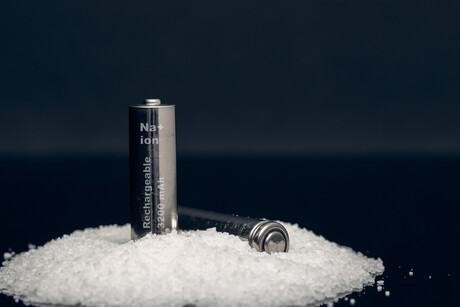
Understanding how battery components work at the molecular or atomic levels can help scientists create faster-charging, more powerful, longer-lived storage devices. But the electron microscopes powerful enough to give this view also change and distort the materials in ways scientists must cautiously appreciate.
“Zooming in and being able to see what happens at the interfaces between battery components is an invaluable tool to diagnose what’s going wrong in our batteries and to figure out how we can heal that problem and fix it in the next generation,” said James Burrow, Deputy Assistant Director of the Department of Energy Storage Research Alliance (ESRA). “To study this, we shine a beam of, in this case, electrons onto our sample. In this process, the electrons interact with the sample and also destroy it. This is something that’s often overlooked in the literature.”
“If you think about water through a hose, the electron dose rate is how much pressure are we applying on the material with our microscope,” said Thomas Marchese, a PhD student at the University of Chicago Pritzker School of Molecular Engineering. “A lot of dose can create a pretty picture in the microscope but if the ‘pressure’ is too high, we can damage the sample. The material we ended up examining is no longer the material that we wanted to study, and our conclusions can be wrong.”
Marchese is the first author of a study published in Microscopy and Microanalysis that explores how this firehose of electrons interacts with the components of sodium batteries — and offers new insights on the utility of tools that are advancing the technology needed to get the planet off fossil fuels.
“Most rechargeable batteries are based on lithium ion, which is powerful but the lithium availability is limited and lithium batteries use some critical minerals such as copper and cobalt that are constrained resources,” said Shirley Meng, co-corresponding author of the new paper. “We need all available battery technologies, including lithium, each put to its best uses. But we also need to harness the practical benefits of readily available materials like sodium and sulfur.”
The research was supported through a cooperative research agreement between UChicago PME, Argonne National Laboratory and Thermo Fisher Scientific through ESRA.
Together, they have developed a state-of-the-art electron microscope that combines efficient detectors for examining both structure and chemistry of materials which together provide complementary diagnostic tools to track the damage and study the materials before damage happens.
“For most materials that we look at in the electron microscope, the dose stability that we need for a typical experiment is in the tens of thousands or hundreds of thousands of electrons per square angstrom,” Marchese said. “With our detectors at Argonne that we’ve worked on with Thermo Fisher Scientific to develop and apply to energy and quantum materials, we’re able to get a lot of information in that first 10 to 50 electrons per angstrom squared before our materials undergo changes.”
This particular study led by Marchese started with a question hauntingly familiar to anyone who owns electronics.
“Why does my phone, laptop, whatever, not keep the same charge that it usually does at the beginning of its life?” Marchese said. In many cases, “Those parasitic losses are often attributed to side reactions and solid electrolyte interphase (SEI) formation. In this study, we’re using electron microscopy to look at a very promising battery where that interphase doesn’t form because we’ve replaced the liquid electrolyte with a stable sodium solid-state electrolyte.”
Smarter charging boosts lithium–tellurium battery performance
An optimised charging strategy could improve lithium–tellurium battery performance by...
Flexible porous material may improve solid-state batteries
A flexible porous material could address contact issues in solid-state batteries, potentially...
X-ray spectroscopy could enable longer-lasting batteries
X-ray spectroscopy and computer modelling offer a faster way to predict chemical interactions and...