Novel membrane paves the way for lithium-free batteries
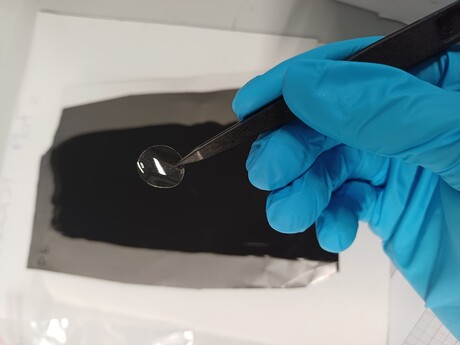
A new polymer electrolyte developed by researchers at Politecnico di Milano could replace lithium ions in batteries. The non-flammable, quasi-solid gel membrane is designed to enable the transport of fluoride ions within batteries at room temperature.
The study, published in the journal Energy Storage Materials, is the outcome of collaboration between several professors and laboratories within the Department of Chemistry, Materials and Chemical Engineering (DCMIC). The study defines the concept of a fluoride exchange membrane (FEM), by analogy with the widely used proton exchange membranes (PEMs), already employed in numerous applications, and anion exchange membranes (AEMs).
The advantages of fluoride-ion batteries are multiple and relevant, starting with their environmental impact, as they could make use of materials that are more readily available and far more abundant than lithium. Moreover, they could play an active role in the energy transition, in energy storage systems needed to store energy generated from renewable sources, thanks to their non-flammability.
“Renewable energy sources have production peaks that occur at times that do not coincide with peak consumption. To address this problem, several European countries are developing storage systems for the energy produced, but the widespread adoption of these systems is often limited by concerns about the fire risk associated with batteries,” said Maurizio Sansotera, Professor of Fundamentals of Chemistry.
“The technology we are developing is based on the use of a non-flammable polymer membrane that reduces the risk of fire, while also offering the advantage of using an element that is abundant and evenly distributed in nature,” Sansotera said.
The batteries are not only safer, they are also lighter and capable of lasting longer, as they could offer higher theoretical energy densities. “We are talking about approximately 600 watt-hours per kilogram, compared with around 150–250 for standard lithium-ion batteries. In practice, this would mean roughly twice the battery life: an electric car could travel twice as many kilometres,” said Luca Magagnin, Professor of Applied Physical Chemistry. “There are many possible applications, from energy storage systems to drones, satellites and aircraft,” Magagnin said.
Another fundamental aspect is that fluoride ion transport in the polymer electrolyte developed takes place at room temperature. “The quasi-solid membrane we have designed enables fluoride ion transport at room temperature. This makes it possible to avoid wasting the energy required to preheat the battery,” said Giuseppina Raffaini, Professor of Chemistry and Materials.
The fluoride-ion gel membrane also makes it possible to overcome dependence on lithium and represents an important step towards the development of next-generation batteries, with the prospect of offering higher energy density, greater safety and improved sustainability.
Hidden cause of perovskite solar cell aging identified
Aging in perovskite solar cells stems from uneven charge losses between neighbouring crystal...
New microscopy insights for sodium batteries
After revealing how electron microscopes damage lithium battery samples, a new study has explored...
Smarter charging boosts lithium–tellurium battery performance
An optimised charging strategy could improve lithium–tellurium battery performance by...