Trace manganese boosts stability of aluminium-foil anodes

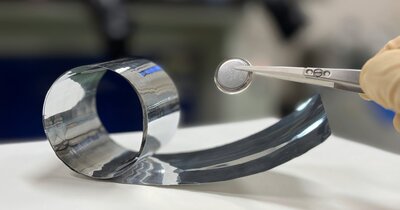
As electric vehicles become more widespread, researchers are looking for ways to make rechargeable batteries store more energy while reducing their environmental impact. Aluminium is a promising candidate, as it can store large amounts of lithium and a single sheet of aluminium foil can serve as the battery’s active material and the component that carries electricity.
However, aluminium does not last long enough during repeated charging and discharging. Now, researchers at Tohoku University have found a way to mitigate this degradation by adding a small amount of manganese to the aluminium. This improves the electrode’s durability without sacrificing its ability to store lithium, addressing a major obstacle to the practical use of aluminium-foil anodes.
In conventional lithium-ion batteries, anodes are typically made by coating a material onto copper foil. Aluminium-foil anodes offer a simpler alternative; as the foil itself stores lithium and carries electricity, it could eliminate the need for copper current collectors, binding materials and energy-intensive coating processes. This could make batteries lighter and more environmentally friendly to produce.
The challenge is that pure aluminium changes as lithium moves in and out during charging and discharging. As lithium is removed, the material develops tiny gaps and becomes porous, weakening its structure. Repeated reactions with the battery electrolyte also create surface layers that interfere with performance. One way to prevent this damage is to add silicon, but this creates another problem: lithium becomes trapped deep inside the material and cannot be fully used. Researchers have therefore struggled to improve the electrode’s lifespan without reducing its usable capacity.
The team found a solution by uniformly dissolving a small amount of manganese into the aluminium, an element that does not readily interact with lithium. The manganese atoms slow the movement of lithium through the aluminium, encouraging the material to develop a fine network of internal boundaries. These boundaries provide pathways that help lithium move through the electrode more easily. As a result, lithium can be removed more thoroughly while the aluminium maintains a dense, stable structure. This helps prevent the damage that would otherwise shorten the electrode’s lifespan.
“Our study demonstrates that the internal microstructure of an electrode can be spontaneously optimised during battery operation simply by adding a trace amount of an element with low lithium affinity,” said Yuki Nakata, an assistant professor at Tohoku University. “By harnessing the material’s intrinsic properties without relying on complex, pre-engineered nanostructures, this approach offers a practical strategy for designing next-generation electrodes.”
The team will now work to extend the electrode’s lifespan further to meet the requirements of commercial batteries. To achieve this, they plan to investigate improved alloy designs and protective surface coatings.
Novel membrane paves the way for lithium-free batteries
A new quasi-solid polymer membrane transports fluoride ions at room temperature, offering a...
Hidden cause of perovskite solar cell aging identified
Aging in perovskite solar cells stems from uneven charge losses between neighbouring crystal...
New microscopy insights for sodium batteries
After revealing how electron microscopes damage lithium battery samples, a new study has explored...