
Forearm trackpads offer a new way to control smartwatches
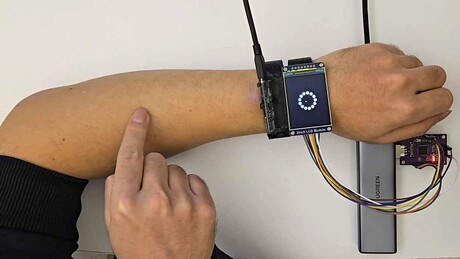
Technology that turns a smartwatch user’s forearm into a trackpad could enable gesture-based controls for scrolling, zooming, clicking on icons and more.
Developed by researchers at North Carolina State University, the system uses radar to track finger movements across the forearm while monitoring pressure on the skin, providing the same level of force-touch detail found on laptop trackpads.
Called EpiPad, the technology transforms the skin of the forearm next to a smartwatch into an interactive trackpad, opening up new possibilities for wearable device interfaces.
“Smartwatch screens are too small for the touch interactions people use every day on phones and laptops, such as two-finger scrolling, pinch-to-zoom, or pressing harder to trigger a different command,” said Chenhan Xu, corresponding author of a paper on the work and an assistant professor of computer science at NC State. “Our goal was to develop a small, wearable technology that would provide that level of interactive control for users.”
“With the EpiPad, a compact millimetre-wave radar worn on a wristband reads the tiny dents fingertips make as they press the skin, so the system tracks multiple fingers and how hard each one presses,” said Yuliang Fu, first author of the paper and a Ph.D. student at NC State. “We want users to interact with their smartwatch in a way that feels familiar, and EpiPad gives people the input expressiveness they would have when using a MacBook trackpad.”
When a user first puts on the EpiPad wristband, they conduct a short series of standard actions that allows the technology to adapt to the new user. Altogether, this calibration process takes less than four minutes.
The existing prototype resembles a wristband with a circuit board sticking out of it. However, the technology could be incorporated into conventional smartwatch devices, with a less obtrusive profile. The actual sensor array that allows EpiPad to monitor motion and force-touch is approximately 5 x 4 mm.
For proof-of-concept testing, the researchers recruited 20 study participants and conducted a range of experiments aimed at evaluating EpiPad’s accuracy and ease of use.
In terms of accuracy, the researchers assessed on-screen tracking accuracy, input gesture recognition and force-touch. EpiPad performed well across all three categories.
“Perhaps the more intuitive evaluation was when we asked study participants to perform a set of real-time smartwatch input tasks using three methods: a traditional touch screen, a tilt cursor and the EpiPad. EpiPad outperformed the other two tasks with regard to both error rate and efficiency,” Fu said.
“This approach could let future smartwatches, and screenless wearables such as AI glasses, use the wearer’s own skin as a full touch surface,” Xu said. “The functional components of the EpiPad, such as the radar sensor array, are relatively inexpensive — and even that cost would go down if these components were incorporated into wearable devices at scale.”
The researchers are looking to work with industry partners to explore how this technology could be incorporated into next-generation devices. “Given the trend of creating smaller and smaller wearable electronics, having an easy and reliable way for users to interact with those devices may be a particularly attractive feature,” Xu said.
Smart textile sleeve integrates display, touch and sensors
A textile-based touchscreen has brought display and touch functions to clothing through...
Graphene hydrogel improves wearable biosensors
A new conductive graphene hydrogel enhances adhesion and flexibility, helping wearable biosensors...
Paint-on electrodes enable smarter wearable sensors
A new conductive ink enables paint-on electrodes that adapt to the skin, enhancing wearable...


