Superconductor advance targets low-power electronics design
Superconducting materials could play a crucial role in the energy-efficient applications of the future. However, several technical challenges still stand in the way of their practical use.
Now, researchers at Chalmers University of Technology in Sweden have developed a new material design that addresses a major obstacle in the field: enabling superconductivity to operate at higher temperatures while also withstanding strong magnetic fields. This breakthrough could pave the way for far more energy-efficient electronics and quantum technologies.
Digital devices, data centres and information and communications technology (ICT) networks currently account for approximately 6 to 12% of global electricity consumption. There is a growing need for more energy-efficient electronics and this is where superconducting materials have emerged as a promising solution. Unlike conventional electronics, which lose energy as heat, superconductors can conduct electricity with zero energy loss. Thus, superconductors have the potential to make power grids, electronics and quantum technologies hundreds of times more energy-efficient.
However, the path to real-world applications is still blocked by several key challenges. One major obstacle is that superconducting states often require extremely low temperatures — down to around –200°C. Cooling to such temperatures is complex and energy-intensive. Another major challenge is that superconductivity can be weakened or destroyed by strong magnetic fields. This is a critical limitation, as magnetic fields are often present in advanced electronic devices and are essential to many quantum technologies. For superconducting technology to move beyond the laboratory and into practical use, materials are therefore needed that can maintain superconductivity at higher temperatures (ideally close to room temperature), while also remaining robust under strong magnetic fields.
Robust superconductivity via new approach
In the search for these kinds of robust superconductors, researchers in the field have tried modifying the chemical composition of a wide range of materials, with limited success. Now, researchers at Chalmers have tried a different route — and taken an important step forward.
“By sculpting the surface that the superconductor rests on, we were able to induce superconductivity at significantly higher temperatures than previously possible. We also found that the material remained superconducting even when exposed to strong magnetic fields,” said Floriana Lombardi, Professor of Quantum Device Physics at Chalmers and lead author of a study published in Nature Communications.
Tiny detail made a huge difference
The Chalmers researchers used a copper-oxide–based material belonging to the cuprate family. Cuprates are well-known superconductors that can operate at rather high temperatures. However, their chemical structure is difficult to tune after fabrication.
The superconducting material itself, used in this study, is only a few nanometres thick — less than one millionth of a hair’s thickness. For practical electronics, such ultrathin films must be deposited on a supporting base, known as a substrate, which provides the necessary template for growth. The breakthrough came when the Chalmers team introduced nanoscale adjustments to the substrate surface.
“Because the atoms in the substrate are arranged in a specific pattern, they can ‘guide’ how the atoms in the superconducting layer settle. By changing the surface design of the substrate, we were able to influence the superconducting properties and ensure they were preserved, even at higher temperatures and when high magnetic fields were applied,” said Eric Walhberg, a researcher at RISE Research Institutes of Sweden.
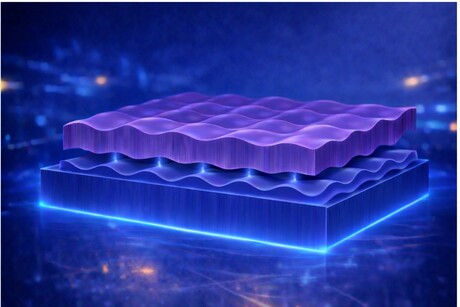
When the researchers pre-treated the substrate in a vacuum and at high temperature, a regular surface pattern formed, consisting of tiny ridges and valleys. This pattern created a kind of electronic landscape in the interfacial region between the substrate and the superconducting material — one that favoured stronger superconductivity.
“We could see how the electrons’ properties began to have a preferential direction in this interfacial region and behave in a way that stabilised and strengthened the superconducting state,” Lombardi said.
A new design principle for future superconductors
With this breakthrough, the researchers introduce a new design principle for developing superconducting materials that may, in the future, reach much higher temperature functionalities, maybe even closer to room temperature.
“Instead of searching for entirely new materials or manipulating the chemical properties of existing ones, we are now showing how superconductivity can be enhanced by sculpting the substrate,” Lombardi said.
These results open the door to practical applications of superconductors in energy-efficient electronics, next-generation quantum components and technologies that require strong magnetic fields.
“This shows that very small changes at the nanoscale can have decisive effects and may even unlock the full potential of superconductivity in future electronics,” Lombardi said.
On-chip quantum memory enables longer photon storage times
Researchers have developed a chip-based quantum memory for longer-term photon storage.
Novel semiconductor device enables low-voltage switching
A gallium oxide-based semiconductor device has demonstrated 0.8 V switching, marking a step...
Neuromorphic chip combines sensing, memory and processing
A new neuromorphic vision chip integrates sensing, memory and processing in one system, enabling...