Alpha-gallium oxide could enable better power electronics
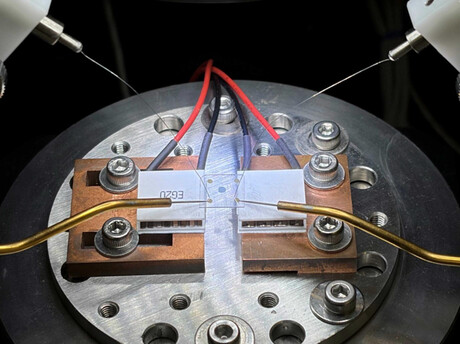
Researchers at Kyoto University and Hokkaido University have measured two key properties of alpha-gallium oxide (α-Ga2O3), a promising semiconductor for next-generation power electronics. The research findings show that adding germanium can improve the movement of electrons through the material without changing how efficiently it conducts heat, providing valuable insights for the development of more efficient and reliable electronic devices.
Alpha-gallium oxide is attracting interest as a semiconductor for high-voltage power devices because it can withstand extremely strong electric fields. However, designing practical devices requires a better understanding of how electrons move through the material and how effectively it conducts heat. Until now, experimental data on these fundamental properties have been limited.
To investigate, the team prepared thin films of alpha-gallium oxide using a technique called mist chemical vapour deposition. They introduced different concentrations of germanium, an element that provides additional conducting electrons, allowing them to examine how electron concentration affects the material’s electrical and thermal properties.
The team first measured the electrical properties of the films, including electron concentration and thermopower, which describes how many electrons move through a material. Then, the researchers estimated the effective mass of electrons, which describes how electrons behave inside a material. They found that this was approximately 40% of a free electron’s mass, higher than the theoretically predicted value of 25%. This difference could be part of the reason that electrons move less easily through alpha-gallium oxide than expected.
The team then measured how efficiently heat travels through the films. They found a thermal conductivity of approximately 19 watts per meter-kelvin. This value remained almost unchanged even when the germanium concentration increased. Together, these results show that adding germanium can improve electron movement without significantly changing heat transfer through the material.
By improving the understanding of how electricity and heat move through alpha-gallium oxide, this research provides a useful foundation for designing future power electronic devices. Further work will be needed to translate this understanding into improved device performance.
Australian-made radiation tests assess Roo-ver electronics
Key electronics for Australia's lunar rover have passed rigorous radiation testing, helping...
New spectrometer uses laser speckle for precise measurements
A new spectrometer turns laser speckle into a measurement tool, resolving wavelengths to six...
Perovskite quantum wells extend spin lifetime at room temp
Perovskite chiral quantum wells sustain spin polarisation 300 times longer at room temperature,...