
New spectrometer uses laser speckle for precise measurements
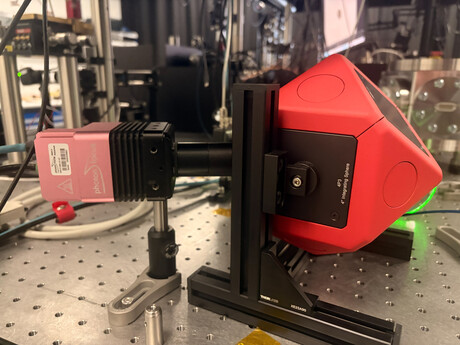
A shoebox-sized colour detection device could enable precise measurements at record resolution, according to new research.
The international research team, led by Adelaide University, exploited an integrating sphere — a highly reflective hollow cavity that causes light to bounce around inside many times before exiting — to demonstrate a device that can measure the colour (wavelength) composition of light with extreme precision at a resolution of just six femtometres.
“For perspective, this is like measuring the exact height of Mount Everest and knowing if someone laid a single strand of human hair on the very top of the peak,” said Gabriel Britto Monteiro, lead author and Higher Degree by Research candidate.
“Optical spectrometers matter because they allow us to measure the colour (wavelength) composition of light with extreme precision, and light carries information about the physical world. A spectrometer shows us the ingredients that make up light and how much of each is present. They are used widely in environmental sensing of pollutants, cancer diagnosis and quantum technologies,” Britto Monteiro said.
Laser speckle, which Britto Monteiro defines as the granular pattern produced when coherent light scatters from a rough or complex surface, is a familiar phenomenon in optics. “It looks like glitter generated with light, and is the reason stars twinkle. We found the resulting speckle pattern became extraordinarily sensitive to minute changes in (colour) wavelength, enabling the device to act as an ultra-high-resolution spectrometer. While speckle has often been considered a nuisance, researchers have increasingly recognised that these patterns are rich in information about the light that generated them,” Britto Monteiro said.
The team used the spectrometer to measure the hyperfine structure of rubidium, an element which is crucial in atomic physics and underpins next-generation atomic clocks and many quantum technologies.
This represents the first direct measurement of atomic hyperfine structure using a speckle-based spectrometer.
“Rubidium underpins technologies such as atomic clocks, quantum processors and quantum sensors. The results demonstrate that speckle-based spectroscopy has matured from a laboratory curiosity into a practical precision measurement platform that could be used in future quantum technologies,” Britto Monteiro said.
The next step for researchers is to combine speckle spectroscopy with a technology called optical frequency combs, which allow users to see tiny details with absolute precision. “This could assist us in better understanding complex gases, to tell two similar-looking chemicals apart,” Britto Monteiro said.
The researchers believe the new technology offers potential benefits to broader applications such as environmental sensing of pollutants, cancer diagnosis and quantum technologies.
The findings were published in the journal Nature Communications.
Perovskite quantum wells extend spin lifetime at room temp
Perovskite chiral quantum wells sustain spin polarisation 300 times longer at room temperature,...
Novel method to reduce metal waste in manufacturing
A new process could separate mixed metal powders for reuse, helping reduce material waste in...
Biohybrid mesh could power implantable electronics
A flexible biohybrid mesh integrates living human cells with piezoelectric materials to harvest...


