Biohybrid mesh could power implantable electronics
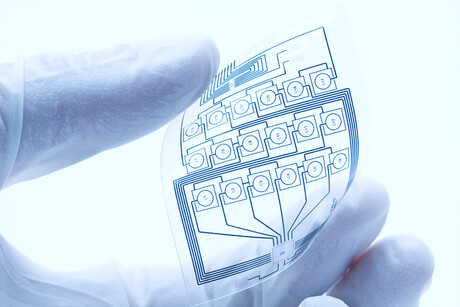
A team of engineers led by the University of Massachusetts Amherst has designed an ultrathin, flexible mesh that integrates electronics with human cells to provide a continuous, reliable and powerful electrical supply. The study, published in Science Advances, provides a potential solution to one of the most difficult problems in the wearable and implantable electronics effort — how to get rid of batteries?
“Humans have long dreamed of a future where certain electronics can augment our abilities,” said Jun Yao, the paper’s senior author. One can think of famous examples from science fiction’s cyborgs, but there are also plenty of everyday examples: pacemakers and implantable defibrillators, for example, or deep brain stimulators, cochlear implants and various health monitors. Every one of these needs a power source.
Unfortunately, the dominant power source — batteries — are bulky and eventually run out of power, and making them smaller and more flexible reduces the charge they can store.
“But our bodies are 24/7 power plants. Every single cell produces its own power,” said lead author Siqi Wang. Some of this power is electrical, such as nerve impulses, and some is mechanical, like the contracting of muscle tissue.
Harvesting that cellular power requires a paradigm shift in electrical engineering, a shift that Yao, who has previously demonstrated a mesh that can grow with and monitor heart tissue, is leading.
The beginning of that shift lay in thinking about how the body is powered. Everything battery powered relies on a centralised supply of energy, but that’s not how the body works. Instead, each cell in a human body is its own power plant and the power is distributed throughout the entire system.
“We wanted to shift this traditional, centralised paradigm to something more distributed and modelled on biology,” Yao said.
The team began with an array of thin ribbons of lead zirconate titanate, or PZT, which converts mechanical energy into electrical energy. They then devised a technique for putting them on an ultrathin, ultra-flexible polymer platform. Next, they seeded this platform with human cardiac cells which, as they grew, meshed seamlessly into and around the PZT-loaded platform. The result is a device that moves and looks like human tissue but works like a battery that never needs to be replaced.
Yao, who is quick to point out that the team’s research so far exists only in the lab, said that their device generated 10 times more power density than those systems that rely on a centralised power source. And that’s just the start. Because these films are ultrathin, they can be stacked in layers, thereby increasing the amount of power on tap while remaining non-invasive.
“The beauty of this system is how non-invasive and powerful it is. Our bodies want to reject systems that come with bulk batteries, but when the device exists at the cellular level, you get vastly improved biocompatibility,” Yao said.
Electrical method could help detect extraterrestrial life
An AI-powered nanogap method can distinguish amino-acid forms, opening a path to compact...
Research identifies hidden network latency bottlenecks
Researchers have identified hidden network latency bottlenecks, revealing where delays occur and...
Optical isolators integrated on silicon photonics chips
A new laser-annealing process integrates optical isolators directly onto silicon photonics chips,...