Internal quantum batteries to power scalable quantum CPUs
Scientists have unveiled a new approach to powering quantum computers using quantum batteries — a breakthrough that could make future computers faster, more reliable and more energy efficient.
Quantum computers rely on the rules of quantum physics to solve problems that could transform computing, medicine, energy, finance, communications and many other fields in the years ahead.
But sustaining their delicate quantum states typically requires room-sized, energy-intensive cryogenic cooling systems, as well as a system of room-temperature electronics.
These infrastructure and energy requirements present barriers to scaling up quantum computers, limiting their size and processing power, restricting their applications and slowing their path to market.
In a new study published in Physical Review X (PRX), a team of researchers from Australia’s national science agency, CSIRO; the University of Queensland; and the Okinawa Institute of Science and Technology (OIST), has theoretically shown how tiny quantum batteries could power a quantum computer — increasing its number of quantum bits (known as qubits) fourfold.
Dr James Quach, co-author of the study and CSIRO’s quantum batteries research lead, explained that the computers use less energy because internal quantum batteries can recycle the energy in the system.
“Quantum batteries are small and mighty. Our findings bring us one step closer to solving the energy, cooling and infrastructure challenges restricting quantum computers. It’s like giving the computer its own internal fuel tank. Instead of constantly refilling it from the electricity grid, the battery recharges while the computer operates,” Quach said.
Quantum batteries are devices that store energy using light, allowing them to recharge simply by being exposed to it. When integrated into a quantum computer, they can be continually recharged by the machine’s own components.
In this system, the battery becomes linked with the computer’s quantum processing units through a phenomenon known as entanglement, creating a shared quantum connection.
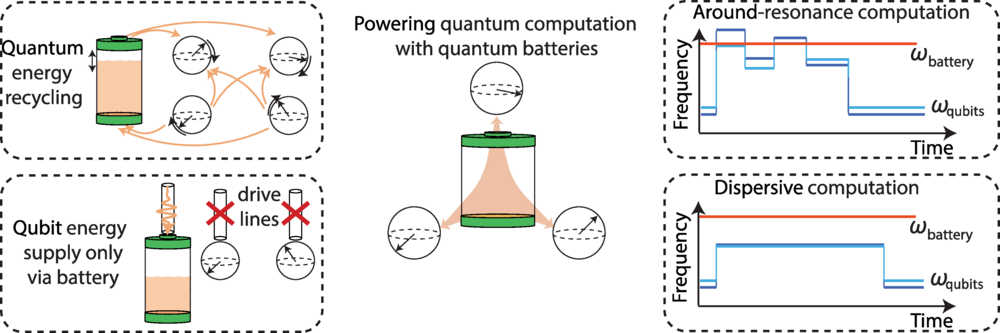
“We’ve calculated that quantum-battery-operated systems will generate significantly less heat, require fewer wiring components, and fit more qubits into the same physical space — all important steps toward building practical, scalable quantum computers,” Quach said.
Modelling also suggests the architecture could improve computational speed through what’s called quantum superextensivity, a phenomenon where the more qubits there are, the faster they are.
“The paper reports the theoretical modelling of how quantum batteries could power existing quantum computers; the team’s next step is to develop a real-world demonstration of this approach. While quantum batteries remain an emerging technology and further development is required, this approach creates exciting possibilities for the future of quantum computing,” Quach said.
Electrical method could help detect extraterrestrial life
An AI-powered nanogap method can distinguish amino-acid forms, opening a path to compact...
Research identifies hidden network latency bottlenecks
Researchers have identified hidden network latency bottlenecks, revealing where delays occur and...
Optical isolators integrated on silicon photonics chips
A new laser-annealing process integrates optical isolators directly onto silicon photonics chips,...