
Laser tech used to develop deformable energy storage device
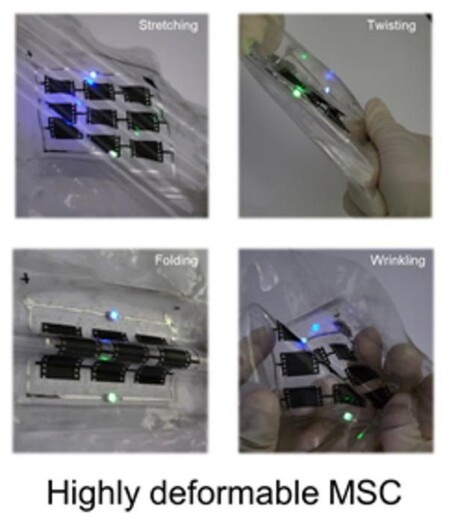
Researchers from the Department of Engineering at Pohang University of Science and Technology (POSTECH) in collaboration with researchers from the Korea Institute of Industrial Technology (KITECH) have developed a small-scale energy storage device capable of stretching, twisting, folding and wrinkling. The research findings were published in the journal npj Flexible Electronics.
The advent of wearable technology has led to a pressing need for energy storage solutions that can keep pace with the flexibility and stretchability of soft electronic devices. Micro supercapacitors — devices that store electricity and deliver powerful electrical output instantaneously when needed — have emerged as a promising candidate for deformable energy storage, due to high power density, rapid charging and long lifecycles. However, the fabrication of interdigitated electrode patterns capable of maintaining the energy storage performance under repeated stretching and twisting remains a challenge, because brittle materials like gold have been commonly used as an electrode. Meanwhile, though eutectic gallium-indium liquid metal (EGaIn) has high conductivity and deformability, a fine patterning of EGaIn is difficult due to its high surface tension.
The researchers fabricated fine patterning by using laser, of both EGaIn and graphene (serving as an active material) layers as on a stretchable polystyrene-block-poly(ethylene-co-butylene)-block-polystyrene copolymer (SEBS) substrate. During the laser ablation of the EGaIn and graphene layers, the underlying stretchable SEBS substrate was not damaged, which maintained the flexibility of the MSG device. The areal capacitance of the resulting MSC retains its original value even after stretching up to 1000 cycles. The fabricated MSCs also operated stably under various mechanical deformations, including stretching, folding, twisting and wrinkling.
Professor Jin Kon Kim of POSTECH said the use of laser-patterned liquid metal electrodes represents a step forward in the development of deformable energy electrode solutions. “As wearable technologies continue to advance, innovations like these will play a vital role in ensuring that our devices can adapt to the demands of our dynamic lifestyles,” Kim said.
Electrical method could help detect extraterrestrial life
An AI-powered nanogap method can distinguish amino-acid forms, opening a path to compact...
Research identifies hidden network latency bottlenecks
Researchers have identified hidden network latency bottlenecks, revealing where delays occur and...
Optical isolators integrated on silicon photonics chips
A new laser-annealing process integrates optical isolators directly onto silicon photonics chips,...


