Terahertz method tracks electronic chips in action

Adelaide University researchers have developed a new way to observe what is happening inside electronic chips while they are operating — without touching them, taking them apart or switching them off.
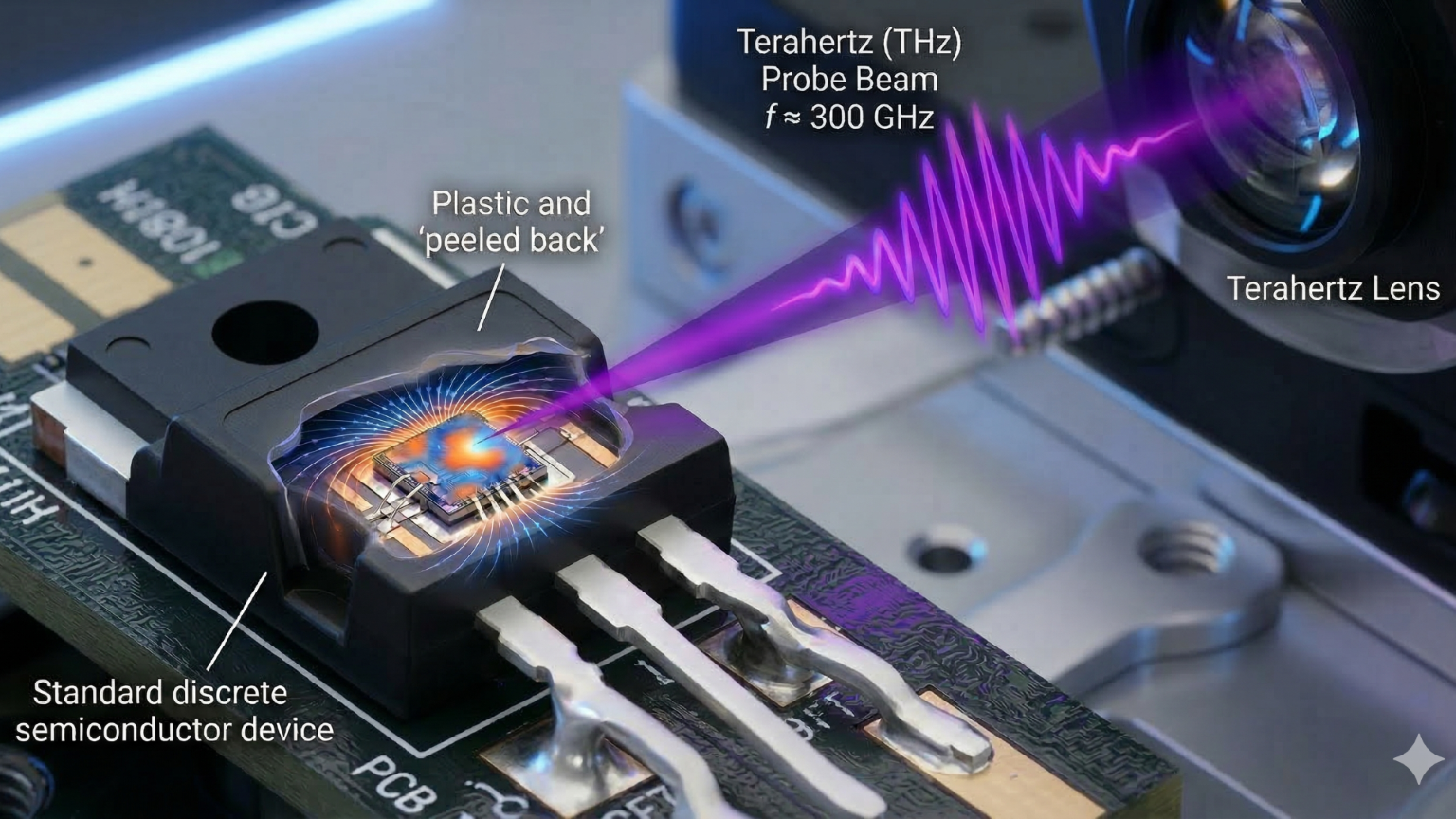
The new technique uses terahertz waves, a safe and non-ionising form of electromagnetic radiation, to detect tiny movements of electrical charge inside fully packaged semiconductor devices. This allows scientists and engineers to monitor electronic components as they function in the real world.
Professor Withawat Withayachumnankul, Adelaide University Group Leader of the Terahertz Engineering Laboratory (TEL), said that semiconductors underpin almost every modern technology, from smartphones and medical devices to vehicles, power grids and defence systems.
“Yet once a chip is sealed inside its protective packaging, it becomes extremely difficult to tell what is happening inside it. Most existing inspection methods require physical electrical probes, exposed chips, or devices to be powered down — making them impractical in many scenarios. This research is a first step towards a longstanding problem in electronics. We can now observe electrical activity inside a working semiconductor device from the outside, without damaging it or interrupting its operation,” Withayachumnankul said.
The study demonstrates that terahertz waves can non-invasively detect changes in electric current inside common electronic components such as diodes and transistors.
The method is sensitive enough to pick up changes occurring in regions far smaller than the terahertz wavelength itself, something previously thought to be impractical due to fundamental noise limits.
To achieve this, the researchers developed an ultra-sensitive detection system using a specialised homodyne quadrature receiver, which can pick up very small changes in terahertz signals.
“This approach allows the system to cancel out background noise and isolate the faint signal produced by electrical activity inside the device. The result is a real-time view of electronics at work, even when the active region is buried deep inside sealed packaging,” Withayachumnankul said.
The researchers say that the signals they observed were caused by genuine electrical motion, not heat or electronic interference. The technique was shown to work across a range of commonly used semiconductor components, demonstrating its robustness and broad relevance.
“Because terahertz radiation is non-ionising and safe, the technique also offers a safer alternative to inspection methods that rely on X-rays or invasive probing. This makes it particularly attractive for safety-critical applications, such as high-power electronics, where devices cannot easily be taken offline,” Withayachumnankul said.
Lead investigator Dr Chitchanok Chuengsatiansup, from the University of Potsdam, said the technique could also be used to remotely and non-invasively assess electronic activity to verify the integrity of critical hardware, detect malfunctioning components and monitor systems where physical access is limited or undesirable.
“This research opens the door to smarter, self-diagnosing electronics, new ways of monitoring complex integrated circuits, and faster development of next-generation chips,” Chuengsatiansup said.
Biohybrid mesh could power implantable electronics
A flexible biohybrid mesh integrates living human cells with piezoelectric materials to harvest...
Electrical method could help detect extraterrestrial life
An AI-powered nanogap method can distinguish amino-acid forms, opening a path to compact...
Research identifies hidden network latency bottlenecks
Researchers have identified hidden network latency bottlenecks, revealing where delays occur and...