Novel transistor enhances sensing in liquids

Accurately measuring small shifts in biological markers, like proteins and neurotransmitters, or harmful chemicals in the water supply can identify critical problems before they have a chance to impact patients or the environment. While some existing sensors can monitor the microscopic matter behind these issues, they often have limitations. A primary example is a device known as a field-effect transistor — a tiny component that controls the flow of electrical current in a system — that struggles to remain stable when exposed to liquid.
Researchers at Penn State have designed a new type of field-effect transistor that can facilitate responsive and versatile sensing, even in liquid-rich environments like the human body. Sensors built with the team’s transistors were up to 20 times more sensitive to various chemical and biological signals, like hazardous chemicals in water or the levels of dopamine in the brain, than other sensors built with comparable transistor designs. The team published their work in npj 2D Materials and Applications.
The technology is based on graphene, a two-dimensional (2D) material that is conductive and highly sensitive to its environment despite being only a few atoms thick. Field-effect transistors used in biosensors have traditionally been constructed with silicon, but are increasingly built with 2D materials like graphene. However, according to Aida Ebrahimi, corresponding author of the paper, when immersed in liquid, these field-effect transistors face signal drift — the sensor’s readings gradually shift over time, even when the inputs measured remain the same, consequently lowering accuracy.
“Aside from signal drift, these devices struggle with electrical leakage and the instability caused by sweeping, a common measurement technique that substantially impacts their reliability over time,” Ebrahimi said. “This makes it difficult to apply these transistors in biointerfaces, like implantable devices, or in any interaction that interfaces with fluid.”
Field-effect transistors essentially work like a tap in a sink, explained Vinay Kammarchedu, an electrical engineering doctoral candidate and first author on the paper. When the tap — or gate, in the language of electronics — is open, the field-effect transistor allows current to flow freely through a system. When the tap or gate closes, the flow stops. However, taking measurements with conventional sensors requires constantly adjusting that tap up and down. According to Kammarchedu, this constant shifting causes instability in the system, leading to inaccurate readings.
“We adjusted the design to have two gates rather than one, allowing us to have independent control over the amount of current flowing through the system,” Kammarchedu said. “Using two gates, we can keep the current running through the system constant, removing a primary cause of signal drift. On top of that, we added a feedback system to one of the gates to more accurately track the impact that molecules have on the sensor’s voltage.”
Kammarchedu explained that the feedback system works by taking advantage of each gate’s different electrical capacity — the top gate has 10 times the capacitance of the bottom gate, meaning it is very sensitive to the environment, while the bottom gate acts as a stiff electronic counterbalance. This relationship between the gates amplifies signals coming through the transistor and substantially increases the sensor’s overall responsiveness.
“If there is a tiny chemical change in the charge at the sensor’s surface, we see it multiplied by 10 in our measurements due to this feedback system,” Kammarchedu said. “This allows us to clearly see very minor changes in chemical readings.”
The team used Penn State’s Nanofabrication Lab to create their transistors, patterning ultra-thin metals, an insulating oxide and a single-atom-thick layer of graphene on top of a base layer made from silicon wafers — polished discs of silicon which serve as a foundational material in chip manufacturing. They then integrated multiple sensors directly into a series of custom circuit boards, which they wired together. To test their design, the team added liquid solutions containing different biological and chemical compounds to the sensors once they were wired into the boards, measuring how well the sensors could track the contents of each sample.
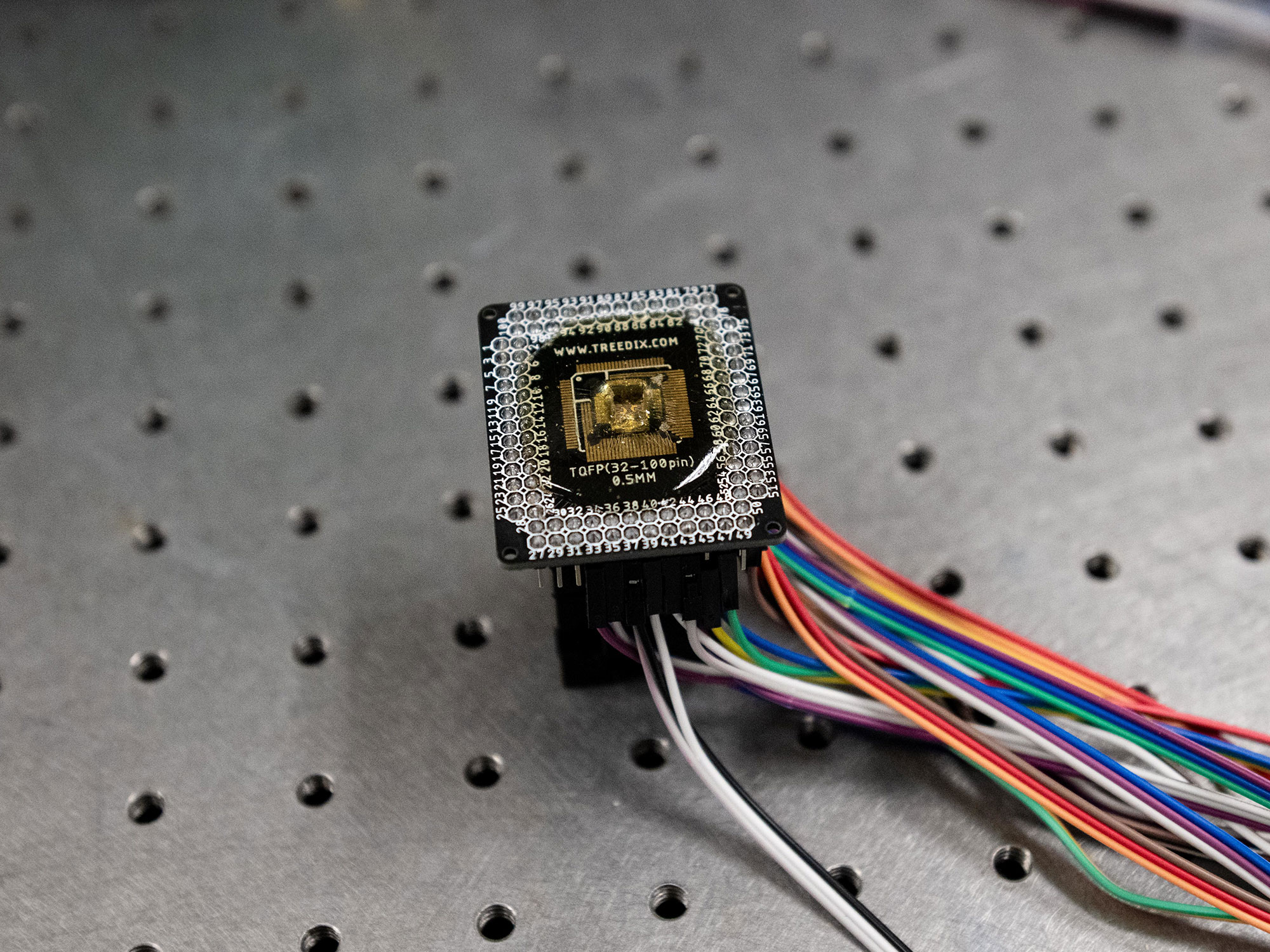
“We can integrate up to 32 sensors and measure each one independently without electrical interference,” Kammarchedu said. “By stacking arrays of these circuit boards together, we can scale up the number of sensors in a system, all while keeping the sensors themselves very small.”
The team’s sensors demonstrated up to 20 times more sensitivity than other conventional single-gate field-effect transistors and up to 15 times less signal drift. According to Ebrahimi, another major highlight of the sensors is that they can effectively monitor a variety of chemical and biological targets — including neurotransmitters like dopamine and serotonin in the brain; IL-6, a protein agent largely responsible for inflammation; and PFAS, the harmful synthetic chemicals that persist in contaminated water, among other environments.
“Not only are the transistors highly resilient to electrical noise and signal drift, but the engineering improvements we’ve introduced increase their sensitivity substantially,” Ebrahimi said. “This makes the sensing applications extremely broad. They can effectively detect chemicals and biomolecules at low concentrations in healthcare applications, and for agriculture and environmental monitoring.”
The team plans to continue developing the sensing architecture and prepare the technology for commercial use. Currently, they are optimising the sensors to identify volatile organic compounds associated with Parkinson’s disease. By detecting the markers earlier, Ebrahimi said, clinicians could potentially improve early interventions. The researchers are also exploring using different 2D materials in their architecture to possibly improve the sensing abilities of their device.
New approach brings OLEDs to microchip scale
A new approach uses photolithography to create densely packed OLED pixels, opening a path towards...
Analog memory boosts computing efficiency
Researchers have developed a new computer memory technology, known as electro-thermo-chemical...
New transistor brings high voltage to microchip scale
By harnessing the properties of gallium nitride, EPFL engineers have built a tiny transistor that...