Self-assembling crystals could lead to safer batteries
A Japanese researcher has identified new solid materials that could lead to the manufacture of non-toxic lithium-ion batteries, with the results published in the journal Science and Technology of Advanced Materials.
Batteries are made of two oppositely charged electrodes separated by a liquid, gel-like or solid electrolyte medium through which electrically charged atoms, or ions, move. In many cases, these electrolytes are toxic and flammable, so researchers have been looking for non-toxic alternatives. Makoto Moriya from Shizuoka University investigated molecular crystals for this purpose.
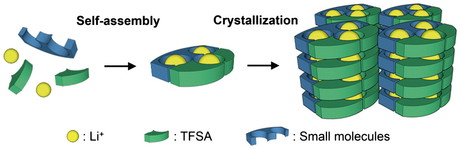
To obtain the crystals he desired, Moriya added an organic compound to lithium salt. The molecules self-assembled to form channels through which lithium ions moved, creating an electric current. Changing the crystals’ structures affected their ion-conducting functions.
Moriya’s study found that ion conductivity in these materials was not as high as in organic liquids, inorganic ceramics or glass electrolytes. However, it was comparable to polymer electrolytes, which have been targeted as potential solid electrolytes. Also, the amount of flammable organic substances in the molecular crystalline electrolytes was lower than in polymer electrolytes and in conventional liquid electrolytes, making them a potentially safer alternative.
Moriya revealed that he found it easy to control the crystal structure of these solid materials by making alterations to their molecules. This structural versatility could therefore prove to be a powerful tool for dramatically improving ion conductivity in these materials.
“These observations ... could open the door to the design of new solid electrolytes and thus the development of new molecular devices,” Moriya stated.
Plasma beam antenna transmits radio waves with lasers
A new plasma beam antenna uses laser-generated plasma to transmit radio waves, potentially...
Degrading dopants could enhance semiconductor performance
A new doping method produces up to 100 times more mobile charges in organic semiconductors,...
Nanoscale polar whirlpools emerge in atom-thin semiconductors
Tiny polar whirlpools found in atom-thin tungsten diselenide could enable new approaches to...