Tiny camera lens may help link quantum computers
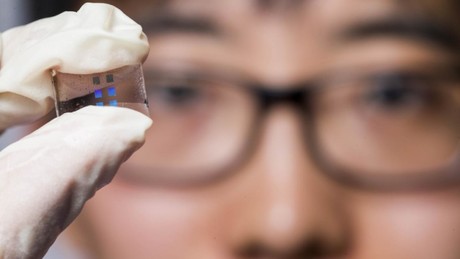
An international research team led by The Australian National University (ANU) has invented a tiny camera lens that may lead to a device that links quantum computers to an optical fibre network.
The camera lens is made of a silicon film with millions of nanostructures forming a metasurface that can control light with functionalities outperforming traditional systems. It was developed and trialled at ANU’s Nonlinear Physics Centre, in collaboration with researchers at the Oak Ridge National Laboratory in the US and the National Central University in Taiwan, and described in the journal Science.
ANU’s Associate Professor Andrey Sukhorukov, who led the research, said the lens is highly transparent, thereby enabling efficient transmission and detection of information encoded in quantum light.
“It is the first of its kind to image several quantum particles of light at once, enabling the observation of their spooky behaviour with ultrasensitive cameras,” he said.
PhD scholar Kai Wang, who worked at the Nonlinear Physics Centre on all aspects of the project, acknowledged the challenges involved in making portable quantum technologies. Nevertheless, the unconventional lens — which is 100 times thinner than a human hair — could enable a fast and reliable transfer of quantum information from new-age quantum computers to a network, once these technologies are fully realised.
“Our device offers a compact, integrated and stable solution for manipulating quantum light. It is fabricated with a similar kind of manufacturing technique used by Intel and NVIDIA for computer chips,” he said.
Wearable glove turns data into thermal sensations
A new wearable glove converts digital information into thermal sensations, allowing users to feel...
Framework enhances synthetic data for AI training
Researchers have developed a set of metrics to evaluate the affinity and diversity of synthetic...
Layered semiconductor shows potential for memory storage
Researchers have discovered that a unique semiconductor undergoes notable structural changes...