Making perovskite solar cells weather-resistant
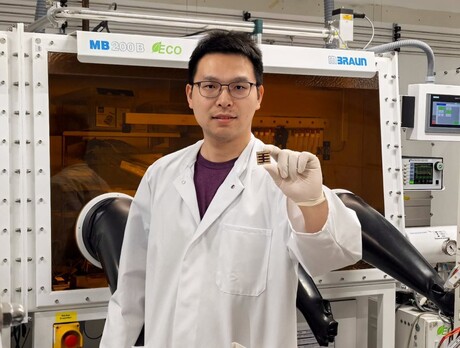
Perovskite solar cells are widely seen as the next big leap in photovoltaics. These devices use a special class of crystalline materials that convert sunlight into electricity with exceptional efficiency. However, their sensitivity to temperature swings has slowed their path to our rooftops. Researchers at the Technical University of Munich (TUM) and the Cluster of Excellence e-conversion have now identified why these promising materials lose their performance — and how they can be stabilised.
Perovskite solar cells are among the most promising technologies for making solar power cheaper and more efficient. Working with partners from the Karlsruhe Institute of Technology (KIT), DESY (Deutsches Elektronen-Synchroton), and the KTH Royal Institute of Technology in Stockholm, the team uncovered the microscopic mechanisms behind the deterioration of the material through temperature swings and developed a strategy to prevent it. Their approach focuses on stabilising the fragile crystal structure with specially designed molecular ‘anchors’.
Beyond the lab: survival in the real world
To achieve the climate goals of tomorrow, solar cells must endure for decades. While perovskites have reached record-breaking efficiencies in converting solar light into electricity, they face a brutal enemy in nature: extreme temperature changes. Experts refer to this as thermal cycling. In a single day, a solar panel can fluctuate from freezing nights to scorching heat. These real-world conditions, repeated heating and cooling, can trigger an early degradation phase in which perovskite solar cells may lose their relative performance.
“If we want these cells on every roof, we have to ensure they don’t just perform in the lab, but endure the stress of the seasons,” said Professor Peter Müller-Buschbaum, Chair of Functional Materials at TUM School of Natural Sciences. His research team works on this challenge and has identified the microscopic causes of this instability. They developed new design strategies to make the top layer of tandem solar cells more robust, enabling them to withstand real-world conditions. Tandem solar cells are made up of stacked solar cells (two in minimum) and therefore make better use of sunlight.
The ‘burn-in’ phase decoded
In a study published in Nature Communications, lead author Dr Kun Sun from the TUM Chair of Functional Materials investigated so-called High-Efficiency Wide-Bandgap cells — the upper cells in a tandem solar cell. Using high-resolution X-ray measurements at DESY, the team watched the material ‘breathe’ in real time during rapid temperature changes; the lattice periodically expanded and contracted in response to rapid temperature fluctuations.
The discovery was striking: degradation happens in a massive initial ‘burn-in’ phase, where cells can lose up to 60% of their relative performance. “We revealed that a microscopic tug-of-war triggers this loss. Tensions arise inside the material and its structure changes — this costs power,” Sun said. This finding gives engineers a clear target: if the burn-in can be eliminated, the engineers can unlock long-term stability.
Designing the ‘perfect anchor’
In a second paper published in ACS Energy Letters, the researchers reported how to stabilise the sensitive crystal material. They used special organic molecules that act as spacers, holding the structure together — like a molecular scaffold.
By comparing different spacers, the researchers found a winner: while common spacers led to structural breakdown, the bulkier organic molecule PDMA acted as a superior anchor. The result is a significantly more robust solar cell that remains stable even under the mechanical stress of rapid heating and cooling.
Perovskite thin film powers devices using indoor light
Researchers have improved perovskite thin films, helping indoor photovoltaics capture light while...
Controlling defects helps improve solar cell performance
UNSW Sydney researchers have uncovered a new way to improve a promising next-generation solar...
Hybrid system integrates power, heating and cooling
A novel hybrid energy system combines electricity generation, heating and cooling under one roof,...