Reviving Edison's nickel–iron battery for modern energy storage
A little-known fact: in the year 1900, electric cars outnumbered gas-powered ones on the American road.
The lead-acid auto battery of the time, courtesy of Thomas Edison, was expensive and had a range of only about 30 miles (approximately 48 kilometres). Seeking to improve on this, Edison believed the nickel–iron battery was the future, with the promise of a 100-mile range, a long life and a recharge time of seven hours, fast for that era.
Alas, that promise never reached fruition. Early electric car batteries still suffered from serious limitations and advances in the internal combustion engine won the day.
Now, an international research collaboration co-led by UCLA has taken a page from Edison’s book, developing nickel–iron battery technology that may be well-suited for storing energy generated at solar farms. The prototype was able to recharge in only seconds, instead of hours, and achieved over 12,000 cycles of draining and recharging — the equivalent of more than 30 years of daily recharges.
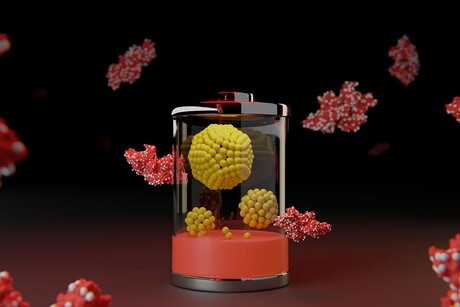
The technology was built from tiny clusters of metal patterned using proteins that were then bonded to a two-dimensional material, made of sheets only one atom thick. Despite the innovative ingredients, the techniques are deceptively straightforward and inexpensive.
“People often think of modern nanotechnology tools as complicated and high-tech, but our approach is surprisingly simple and straightforward,” said study co-author Maher El-Kady, an assistant researcher in the UCLA College’s chemistry and biochemistry department. “We are just mixing common ingredients, applying gentle heating steps and using raw materials that are widely available.”
The study was published in the journal Small.
Batteries that get an assist from biology
The natural world provided some cues for the researchers. Of particular interest was the process by which animals form bones and shellfish form their hard outer casings. Whether skeletons are inside or outside, they’re made by proteins that act as scaffolds for collecting calcium-based compounds.
The researchers sought to mimic this mechanism to generate their tiny clusters of nickel or iron, according to co-corresponding author Ric Kaner, a distinguished professor of chemistry and biochemistry in the UCLA College.
“We were inspired by the way nature deposits these types of materials,” Kaner said. “Laying down minerals in the correct fashion builds bones that are strong, yet flexible enough to not be brittle. How it’s done is almost as important as the material used, and proteins guide how they are placed.”
In the study, the team used proteins that are by-products of beef production. The molecules served as templates for growing clusters of nickel for positive electrodes and iron for negative electrodes. The nooks and crannies in the folded protein structure limited the size of the metal clusters to fewer than 5 nanometres. That’s so small that it would take about 10,000 to 20,000 clusters to match the width of a human hair. The researchers even detected single atoms of iron and nickel in their electrodes.
The proteins were combined with graphene oxide, an ultra-thin 2D material that comes in sheets a single atom thick comprising carbon decorated with oxygen atoms. While the oxygen can create clogs that make the material act more like an insulator, the process that followed changed everything.
The ingredients were superheated in water then baked at high temperature, causing the proteins to char into carbon, stripping away the oxygen in the 2D material and embedding the tiny metal clusters guided by the proteins. The resulting structure was an aerogel, made of almost 99% air by volume.
Surface area as a superpower
Part of the technology’s secret sauce is surface area — the more exposed, the more space for the reactions behind battery chemistry to take place.
There was plenty of such room provided by the graphene aerogel’s thinness and surplus of empty space. And the tininess of the metal nanoclusters takes advantage of a fundamental mathematical principle: as objects get smaller, the size of the exposed outer surface increases far more than volume does.
“As we go from larger particles down to these extremely tiny nanoclusters, the surface area gets dramatically higher,” El-Kady said. “That’s a huge advantage for batteries. When the particles are that tiny, almost every single atom can participate in the reaction. So, charging and discharging happen way faster, you can store more charge, and the whole battery just works more efficiently.”
Prospects for the future and next steps
Despite its advantages in charging speed and durability, this iteration of the technology does not match the storage capabilities of today’s lithium-ion batteries. With range at a premium in the electric car market, the researchers think that this Edison-inspired battery of the future may one day find application in other areas.
For instance, the technology’s fast charging, high output and robust endurance suggest a good fit for storing excess electricity generated at solar farms during the daytime, to power the grid at night. It may also be useful for back-up power at data centres.
“Because this technology could extend the lifetime of batteries to decades upon decades, it might be ideal for storing renewable energy or quickly taking over when power is lost,” El-Kady said. “This would remove worries about the changing cost of infrastructure.”
The researchers are exploring the use of their nanocluster fabrication technique with other metals. They’re also looking at possible replacements for bovine proteins, such as natural polymers that are more abundant, and thus less expensive and easier to scale up for future manufacturing.
Polymer binder advances sustainable battery design
A new, fluorine-free battery binder could make lithium-ion batteries more environmentally...
Bypassing weak cells could extend EV battery pack lifespan
Reconfigurable EV battery packs could last longer by bypassing weaker cells, with modelling...
Perovskite solar cells take flight for testing in space
Next-gen perovskite solar cells are heading into space aboard the CRIMSON-1 satellite, where...