Indoor photovoltaics enable battery-free wearables
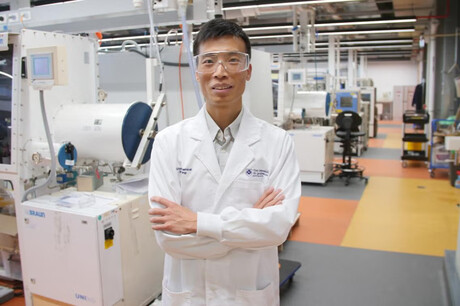
Wearable health devices that never need charging are a step closer thanks to next-generation photovoltaic technology that harvests energy from indoor light, as well as the sun.
While perovskite indoor photovoltaics have emerged as one of the most promising power sources for wearable health devices, toxic lead content has prevented their use in skin-contact applications.
University of Queensland researchers are overcoming this barrier by developing lead-free, low-toxicity and efficient indoor photovoltaics that can be customised to power a range of personal wearable devices.
UQ chemical engineer Dr Miaoqiang Lyu said indoor photovoltaics could unlock a critical missing capability in wearable health devices: truly energy-autonomous, continuous operation — without batteries, without charging and without interruption to data collection.
“Wearable health devices such as glucose sensors, ECG patches and sweat-based lactate and electrolyte patches support preventative health care and improve quality of life, but limitations with their batteries can be challenging for users,” Lyu said.
Lyu has received a UQ Foundation Research Excellence Award (FREA) to progress the work and develop a prototype for powering wearable health-monitoring sensors.
The project builds on Lyu’s long-term research developing perovskite photovoltaic technologies that are cost-effective, high-performing and environmentally safer.
His team has already developed a scalable vapour-deposition method that removes toxic lead and hazardous solvents from indoor photovoltaic manufacturing while delivering record performance for lead-free perovskite devices.
Lyu said the FREA-supported research will advance lead-free perovskite indoor photovoltaics using thermal evaporation, an industry-compatible process with strong scale-up potential.
Beyond wearable devices, indoor photovoltaics could contribute to a broader shift towards self-powered electronics that harvest energy from everyday indoor environments.
“The potential benefits are particularly relevant for people managing chronic illness, and communities in regional and remote locations where access to healthcare services can be more challenging,” Lyu said.
Flexible porous material may improve solid-state batteries
A flexible porous material could address contact issues in solid-state batteries, potentially...
X-ray spectroscopy could enable longer-lasting batteries
X-ray spectroscopy and computer modelling offer a faster way to predict chemical interactions and...
Sodium sulfur battery project links Queensland to the grid
A new sodium-sulfur battery system in Brisbane uses Queensland-made DC-DC converters to connect...