New efficiency benchmark for CIGS–perovskite tandem solar cell
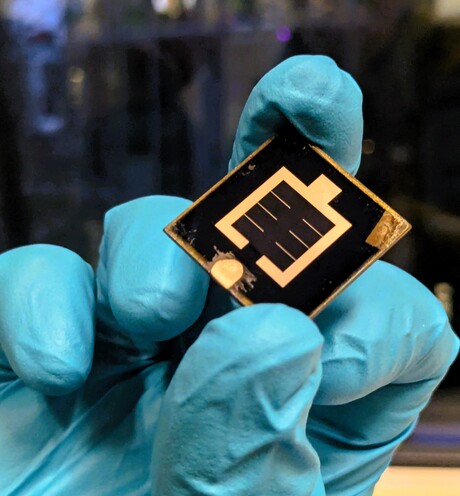
Combining two semiconductor thin films into a tandem solar cell can achieve high efficiencies with a minimal environmental footprint, as demonstrated by the setting of a new world record.
Thin-film solar cells require little energy and material to produce and therefore have a very small environmental footprint. In addition to the well-known and market-leading silicon solar cells, there are also thin-film solar cells, eg, based on copper, indium, gallium and selenium, known as CIGS cells. CIGS thin films can even be applied to flexible substrates.
Now, experts from HZB and Humboldt University Berlin have developed a new tandem solar cell that combines a bottom cell made of CIGS with a top cell based on perovskite. By improving the contact layers between the top and bottom cells, they were able to increase the efficiency to 24.6 %. This is reportedly the current world record, as certified by the Fraunhofer Institute for Solar Energy Systems ISE in Freiburg, Germany.

As always, this record cell was the result of a successful team effort: the top cell was fabricated by TU Berlin master’s student Thede Mehlhop under the supervision of Stefan Gall. The perovskite absorber layer was produced in the joint laboratory of HZB and Humboldt University of Berlin. The CIGS sub-cell and contact layers were fabricated by HZB researcher Guillermo Farias Basulto. He also used the high-performance cluster system KOALA, which enables the deposition of perovskites and contact layers in vacuum at HZB.
“At HZB, we have highly specialised laboratories and experts who are top performers in their fields. With this world record tandem cell, they have once again shown how fruitfully they work together,” said Professor Rutger Schlatmann, spokesman for the Solar Energy Department at HZB.
The record announced today is not the first world record at HZB: HZB teams have already achieved world record values for tandem solar cells several times, most recently for silicon–perovskite tandem solar cells, but also with the combination CIGS–perovskite.
“We are confident that CIGS–perovskite tandem cells can achieve much higher efficiencies, probably more than 30%,” Schlatmann said.
X-ray spectroscopy could enable longer-lasting batteries
X-ray spectroscopy and computer modelling offer a faster way to predict chemical interactions and...
Sodium sulfur battery project links Queensland to the grid
A new sodium-sulfur battery system in Brisbane uses Queensland-made DC-DC converters to connect...
Indoor photovoltaics enable battery-free wearables
University of Queensland researchers are developing lead-free indoor photovoltaic technology to...