
Electronic skin combines sensing, visualisation in one device
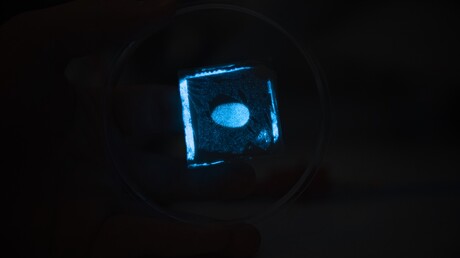
Researchers from the National University of Singapore (NUS) have developed an electronic skin that can sense and directly visualise pressure in real time, addressing key limitations of current wearable sensing technologies.
Electronic skin systems are prevalent in health care, robotics and wearables, with most systems relying on arrays of sensors connected to external electronics for signal processing and display. These designs often face limitations such as low spatial resolution, wiring complexity and inefficient signal interpretation, making intuitive real-time feedback difficult.
Now, a team of researchers led by Professor Lim Chwee Teck from NUS has developed a soft, ultrathin device called the ‘eLuminator’. Unlike traditional electronic skins that rely on discrete sensing pixels, the eLuminator uses a continuous, pixel-free design. With a spatial resolution of approximately 30 µm (847 dpi), it can detect much finer pressure details, enabling high-precision tactile sensing for advanced applications.
The eLuminator is approximately 70 µm thick and made of flexible, non-toxic materials designed to mimic the mechanical properties of human skin. It can stretch beyond 100% strain and conform to curved surfaces such as the body or medical devices.
The device remains stable under repeated mechanical stress, with consistent performance demonstrated over more than 1000 to 4000 cycles. It also operates across a broad pressure range, from light touch to approximately 180 kPa (similar to the pressure felt when balancing a heavy textbook on a fingertip), making it suitable for diverse applications.
At the core of the technology is a mechano-electroluminescent response, where applied pressure directly changes the device’s light emission. When pressure is applied, the device generates visible light patterns that map both the magnitude and shape of contact. This enables immediate and intuitive visualisation without the need for separate processing or display systems.
The high-resolution luminescent response allows fine surface features such as the ridges and valleys of fingerprints to be clearly captured in real time, demonstrating its capability for detailed tactile imaging and potential use in biometric applications.
“This technology transforms how we interact with tactile information. Instead of relying on complex electronics, users can immediately see force distribution as it happens, making the process far more intuitive,” Lim said.
The eLuminator is suitable for surgical training and healthcare monitoring, where precise force control is critical but difficult to achieve due to the lack of tactile feedback.
Beyond health care, the device enables a more responsive human–machine interface. It supports both static and dynamic sensing, with optical feedback of around 15 milliseconds and digital readout of around 110 milliseconds, allowing force interactions to be visualised and quantified in near-real time. Its high sensitivity also enables the detection of gentle touches, which is important for robotics and prosthetics.
By combining visual and digital sensing in a single system, the eLuminator simplifies device design and enables easier integration into next-generation wearable and biomedical technologies.
The research team is working to further improve the device’s sensitivity and reduce its power requirements, while advancing deployment in high-impact healthcare applications.
The research findings have been published in Nature Communications.
Ultra-thin fibre microphone monitors power grid systems
Immune to extreme heat and high voltage, the new device could listen for problems inside...
AI-powered wearable turns gestures into robot commands
A new wearable system uses stretchable electronics and artificial intelligence to interpret human...
Graphene-based solar cells power temperature sensors
Researchers have demonstrated the ultra-low-power temperature sensors powered by graphene-based...


