
Novel method to reduce metal waste in manufacturing
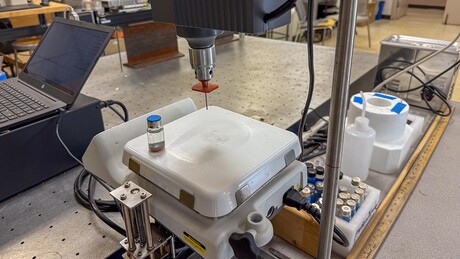
A new process developed at the University of Maine could help recover mixed or cross-contaminated metal powders for reuse in 3D printing, sintering and other powder-based manufacturing processes.
Metal powders are essential for manufacturing a range of precision-engineered components, from aircraft parts and cutting tools to battery materials and biomedical implants. However, when powders become mixed during material changes, handling, recovery or multimaterial 3D printing, they may no longer meet the requirements for reuse.
As a result, contaminated feedstock, leftover powders and material from failed production attempts can be discarded despite containing valuable metals. By offering a potential route to recover these materials, the new process could help manufacturers make better use of metal resources and reduce waste in powder-based production.
The new method, called shear-assisted particle entrapment (SHAPE), separates microscopic metal particles and captures them in a polymer film. In a study published in Powder Technology, researchers tested the process using aluminium and copper powders mixed in a liquid and placed in a spinning machine.
“We’re trying to solve a significant materials-loss problem that occurs during the production of high-value components and products across critical sectors, such as aerospace, energy storage, tooling, biomedical devices and electronics,” said lead researcher Bashir Khoda.
Khoda, a UMaine associate professor of mechanical engineering and an associate faculty member with the Advanced Structures and Composites Centre (ASCC), said his team’s findings could be particularly relevant to 3D printing and other powder-based additive manufacturing processes, in which metal powders can become mixed.
Khoda said recovering the particles without melting and completely reprocessing them could eventually reduce material waste, energy-intensive reprocessing and demand for new raw materials.
“Our longer-term objective is not simply to separate particles in the laboratory, but to develop a scalable and AI-driven manufacturing system that could recover cross-contaminated powders and return usable material to the additive manufacturing supply chain and beyond,” Khoda said.
The particle entrapment method was devised in collaboration with William Gramlich, associate professor of chemistry and associate faculty member with the ASCC. Researchers tested aluminium and copper microparticles between 0 and 25 micrometres in diameter. The particles were mixed in a liquid carrier and subjected to rotational speeds ranging from 200 to 1500 revolutions per minute (rpm).
The team found that fine-tuning process parameters resulted in different particles being captured. At approximately 200 rpm, about 87% of the particles captured on the substrate were aluminium. As rotational speed increased, copper became increasingly dominant. At 1500 rpm, about 90% of the entrapped particles were copper.
“What makes this interesting for separation is that different particles respond differently to the same flow conditions,” Khoda said.
Although the researchers achieved high particle-level selectivity, the overall amount of material captured from the starting mixture remained relatively low under laboratory conditions.
“The current study demonstrates the selectivity of the mechanism, rather than an industrially ready recovery process. The next challenge is to maintain this selectivity while substantially increasing the amount of material that can be processed and recovered,” Khoda said.
Future research will examine ways to increase the amount of material processed while maintaining selective separation. Researchers are investigating substrate size and geometry, the use of multiple substrates, particle loading, polymer concentration, processing time and continuous or multistage operation.
Biohybrid mesh could power implantable electronics
A flexible biohybrid mesh integrates living human cells with piezoelectric materials to harvest...
Electrical method could help detect extraterrestrial life
An AI-powered nanogap method can distinguish amino-acid forms, opening a path to compact...
Research identifies hidden network latency bottlenecks
Researchers have identified hidden network latency bottlenecks, revealing where delays occur and...


